Try our service free
→ Discover complimentary downloads without needing a payment method.
Browse free




reFX Rippler Review: Features, Sounds & Workflow
By PluginsBoutique Team · August 8, 2026
🎹 SYNTH PLUGINS · REVIEW
reFX Rippler Review
reFX Rippler Review
Physical Modeling Synth Explained
Explore the resonator-based synthesizer from reFX, including its physical modeling engine, acoustic models, modulation system, MPE support, microtuning, and sound-design workflow.
🎛 Physical / Modal Modeling
🎚 Subtractive Synthesis
💻 Mac & Windows
⏱ 9 min read
12
Acoustic Models
441
Factory Presets
2
Synthesis Layers
MPE
Expressive Control
32
Exciter Samples
Mac + PC
Platforms
Quick Answer
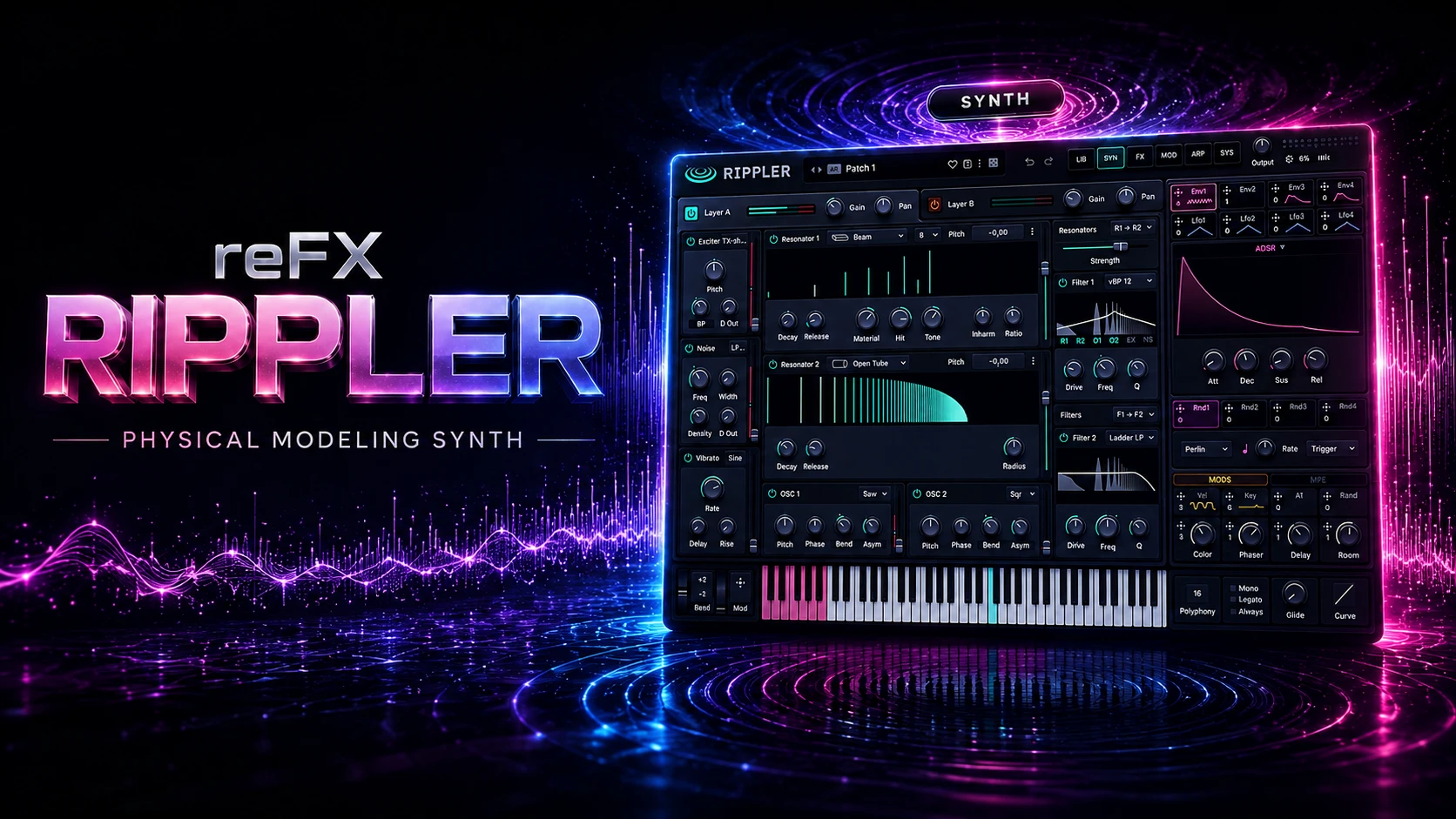
reFX Rippler is a hybrid synthesizer that combines physical/modal modeling with subtractive synthesis. Its resonator system is designed to create acoustic-inspired, resonant, metallic, percussive, atmospheric, and experimental sounds. The instrument adds dual synthesis layers, extensive modulation, flexible effects, MPE and aftertouch, alternative tuning, external audio input, and custom resonator configurations.
What Is reFX Rippler?
reFX Rippler is a hybrid software synthesizer that combines physical/modal modeling and subtractive synthesis to create distinctive electronic and acoustic-inspired sounds.
Rather than relying entirely on conventional oscillator waveforms or sample playback, Rippler places modeled resonators at the center of its sound-generation approach.
This makes it particularly interesting for producers who want something different from a traditional subtractive or wavetable synthesizer.
The key idea:
Rippler's acoustic models are not simply intended to reproduce
traditional instruments. They can be used as starting points for
synthetic, metallic, percussive, atmospheric, and experimental
sound design.
Why Is Physical Modeling Interesting?
Traditional synthesis usually begins with an oscillator. You choose a waveform, shape it with filters and envelopes, add modulation, and then process the result with effects.
Physical modeling approaches sound from another direction. Instead of only defining the waveform, the synthesis process can simulate the behavior of a resonating structure.
In Rippler, these resonant structures can become the foundation for plucks, bells, percussion, metallic tones, evolving textures, pads, and unusual electronic instruments.
The 12 Acoustic Models
Rippler includes 12 acoustic models representing different types of resonant structures. The official specifications include models based on strings, drumheads, beams, djembe, vibraphone, bells, marimba, membranes, tubes, plates, and related structures.
🎸
Strings
Useful for plucked, resonant, melodic, and evolving tonal sounds that can move well beyond traditional string emulation.
🥁
Percussion
Drumhead, djembe, and membrane-style models provide a foundation for pitched and experimental percussion textures.
🔔
Bells & Mallets
Bell, vibraphone, and marimba-inspired structures can create tonal percussion and cinematic textures.
🌀
Tubes & Plates
Resonant tube and plate structures can produce hollow, metallic, unusual, and experimental timbres.
Dual-Layer Sound Design
Rippler provides two independent synthesis layers, allowing producers to combine different sound sources inside a single instrument.
The layers can be routed through resonators in parallel or serial configurations. This gives you more control over how the different parts of a patch interact.
One layer can provide the initial attack while another adds body, resonance, movement, or a contrasting texture.
Modulation & Mod Mapping
Modulation is an important part of the Rippler workflow. Multiple modulation sources can be connected to different parameters using its drag-and-drop modulation system.
Mod Mapping allows you to shape how a modulation source affects its destination. Instead of relying only on a simple linear response, you can create different response curves for more controlled movement.
💡 Sound Design Tip
Don't limit modulation to filter cutoff. Try using modulation on resonator parameters, layer controls, effect parameters, and other less obvious destinations to create more evolving sounds.
Modular Effects Chain
Rippler includes a modular effects system with 13 effects available on the master bus and 12 effects per layer.
Effects can be arranged in different orders, allowing the processing chain to become part of the sound-design process.
Changing the order of distortion, filtering, delay, reverb, and other effects can significantly change the character of the finished patch.
MPE & Aftertouch
Rippler supports MPE and aftertouch, making it suitable for expressive controllers that provide more detailed performance information than standard MIDI note triggering.
This can be particularly useful for expressive leads, evolving pads, cinematic textures, and experimental instruments where performance gestures need to influence individual notes.
Microtuning & MTS Support
Rippler supports alternative tuning through Scala
.scl and .kbm files as well as MTS
Client.
This allows producers and composers to experiment with tuning systems outside standard twelve-tone equal temperament.
External Audio Input
Rippler can also use external audio as an input source for its resonators.
This creates a different sound-design workflow because your source material does not have to originate inside the synthesizer. Percussion, vocals, field recordings, synthesizers, and other audio can become material for resonator processing.
Creative idea:
Try feeding a short percussive sound into a resonator and then
experiment with tuning, modulation, and effects. The result can
become a completely different playable instrument.
Manual Mode & Experimental Sound Design
Rippler includes a Manual Mode for creating custom resonator configurations. Snapshot morphing can then be used to move between different configurations.
This gives advanced sound designers another way to explore unusual relationships between resonators rather than relying exclusively on factory models.
Factory Content & Presets
The official reFX specifications list 441 factory sound presets, 32 exciter samples, 10 arpeggiator presets, and 64 LFO shapes.
| Content | Included |
|---|---|
| Factory Sound Presets | 441 |
| Exciter Samples | 32 |
| Arpeggiator Presets | 10 |
| LFO Shapes | 64 |
| Acoustic Models | 12 |
Who Is Rippler For?
🎧
Electronic Producers
Useful for unusual plucks, resonant basses, percussion, metallic textures, and evolving synth sounds.
🎬
Film & Game Composers
The physical-modeling approach can provide organic, atmospheric, and experimental cinematic textures.
🎛️
Sound Designers
Custom resonators, modulation, effects, and audio input provide plenty of opportunities for experimentation.
🌌
Ambient Producers
Long resonances and evolving modulation can be used for atmospheric and spacious sound design.
Rippler vs Traditional Synthesizers
Rippler's main attraction is not that it replaces every other synthesizer. Its value is that it provides a different route to sound generation.
| Capability | reFX Rippler | Traditional Synth |
|---|---|---|
| Physical / Modal Modeling | Core sound-generation approach | Depends on instrument |
| Acoustic Resonator Models | 12 | Varies |
| Subtractive Synthesis | Yes | Common |
| Dual Layers | Yes | Varies |
| MPE | Yes | Varies |
| Alternative Tuning | Scala + MTS | Varies |
| External Audio Input | Yes | Varies |
System Requirements
🍎
macOS
- macOS 10.13 or later
- Apple Silicon M1 native support
- 8 GB RAM minimum
- 16 GB RAM recommended
- 1024 × 768 display or higher
- 64-bit system
- AU, VST3 or AAX host
- Internet connection for license download
🪟
Windows
- Windows 10 or Windows 11
- Compatible Intel or AMD processor
- 8 GB RAM minimum
- 16 GB RAM recommended
- 1024 × 768 display or higher
- 64-bit system
- VST3 or AAX host
- Internet connection for license download
Pros & Considerations
✓ What Stands Out
- ✓ Physical/modal modeling approach
- ✓ 12 acoustic models
- ✓ Dual synthesis layers
- ✓ Extensive modulation
- ✓ Flexible effects routing
- ✓ MPE and aftertouch
- ✓ Scala and MTS support
- ✓ External audio input
- ✓ Custom resonator configurations
△ Things to Consider
- △ Its workflow differs from traditional synths.
- △ The resonator architecture may take time to learn.
- △ Advanced features can require experimentation.
- △ Check the latest official release information before purchase.
Final Verdict
reFX Rippler takes a distinctive approach to synthesis by putting physical/modal modeling and resonators at the center of the instrument while still providing subtractive synthesis features.
Its combination of acoustic models, dual layers, modulation, effects, MPE, alternative tuning, external audio input, and custom resonator configurations gives sound designers several different ways to approach a patch.
If your studio already contains conventional synthesizers and you're looking for a different sound-generation method, Rippler is an interesting instrument to watch. Its resonator-based workflow can move between acoustic-inspired sounds and highly experimental electronic textures.
Got Questions?
Frequently Asked Questions
Common questions about reFX Rippler, its synthesis engine, compatibility, presets, and sound-design features.
reFX Rippler is a hybrid synthesizer combining physical/modal modeling, resonator-based synthesis, and subtractive synthesis.
Rippler includes 12 acoustic models based on different types of resonating structures.
The official specifications list 441 factory sound presets, along with 32 exciter samples, 10 arpeggiator presets, and 64 LFO shapes.
Yes. Rippler supports MPE and aftertouch for expressive performance control.
Yes. External audio can be routed into the resonators for additional sound-design possibilities.
Yes. Rippler supports Scala tuning files and MTS Client.
FL Studio is listed among the compatible host applications in the official reFX specifications.
Yes. The official requirements list native Apple Silicon M1 support for the Mac version.
Yes. Its resonator engine, modulation system, effects, external audio input, MPE support, and Manual Mode provide several tools for experimental sound design.
Rippler places physical/modal modeling and resonator-based sound generation much closer to the center of its workflow, giving producers a different approach from conventional oscillator-based synthesis.
Ready to Explore reFX Rippler?
Discover a different approach to synthesis with physical modeling, resonators, modulation, expressive control, and experimental sound-design possibilities.
Explore reFX Rippler →Product specifications are based on information published by reFX. Always check the developer's latest documentation for current compatibility and release information.