Try our service free
→ Discover complimentary downloads without needing a payment method.
Browse free




Remanence Audio Iron Glass Review: A New Approach to Analog EQ
By PluginsBoutique Team · August 8, 2026
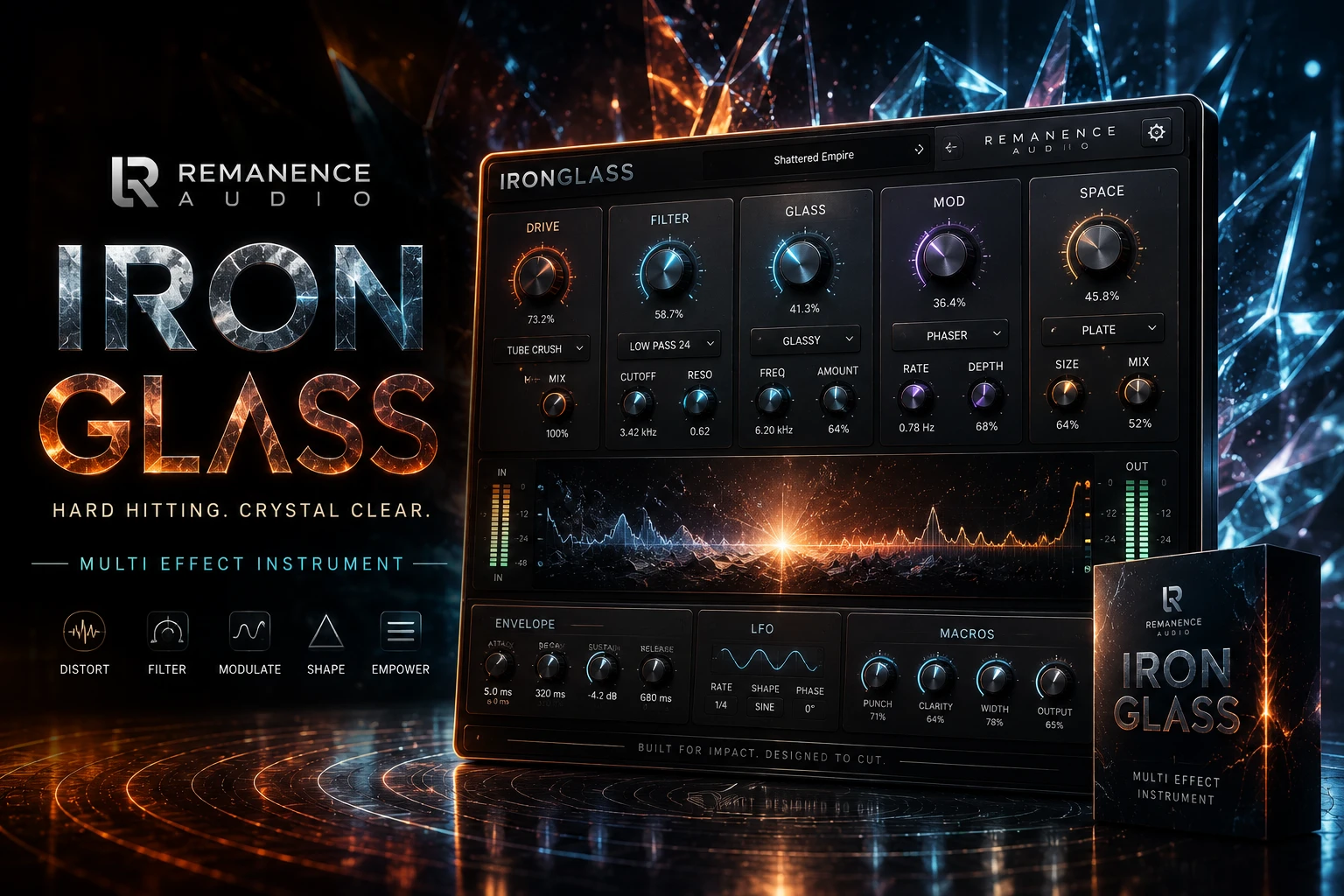
CIRCUIT-MODELED MASTERING EQ
Remanence Audio Iron Glass
A five-band circuit-modeled EQ built around tubes, transformers and an inductor network for detailed mastering and analog-style tonal shaping.
5 Parallel EQ Bands
Tube Modeling
Transformer Modeling
VST3 / AU / AAX
Remanence Audio Iron Glass takes a different approach to analog-style EQ by modeling the tubes, transformers and inductor network that form the processing architecture.
What Is Remanence Audio Iron Glass?
Iron Glass is a circuit-modeled equalizer designed primarily for mixing and mastering applications.
Its architecture combines five parallel EQ bands with modeled tube stages, transformers and an inductor network.
The result is a processor designed to combine frequency shaping with the behavior and character of the modeled analog circuitry.
5
Parallel EQ Bands
±18 dB
Input / Output Gain
14 Days
Fully Functional Trial
Explore Iron Glass
Visit the PluginsBoutique product page for Remanence Audio Iron Glass and current availability.
Five Parallel EQ Bands
The central EQ architecture uses five bands that operate in parallel and are blended back into the signal.
This approach is designed around the behavior of classic passive-style equalization and allows the frequency-shaping stages to contribute to the overall character of the processor.
01
Parallel Processing
Five EQ bands work on the same signal and are combined rather than simply stacked one after another.
02
Broad Tonal Shaping
The architecture is suited to musical broad-band adjustments during mixing and mastering.
03
Analog Circuit Approach
The EQ is part of a modeled circuit rather than being isolated from the analog-style stages.
04
Mastering Workflow
Use subtle EQ moves while allowing the circuit stages to contribute additional character.
Tube and Transformer Modeling
Iron Glass models its tube and transformer stages as part of the processing architecture.
The available controls can alter the characteristics of these modeled stages rather than simply applying a generic saturation effect.
Analog Character Comes From the Circuit
Iron Glass was developed around circuit models of the tubes, transformers and inductor network rather than simply placing a saturation effect around a conventional digital EQ.
The Iron Memory Concept
The name Remanence Audio is connected to the behavior of magnetic material in transformers.
When transformer iron is driven into saturation, its behavior can remain influenced by what happened immediately before the current signal.
The developer identifies this behavior as an important part of the depth and feel following transients.
Modeled Inductor Network
Iron Glass also incorporates an inductor network into its circuit design.
The high-pass and low-pass filtering is designed around this modeled circuitry rather than being implemented simply as generic digital filters.
High-Pass and Low-Pass Filtering
- Remove unwanted sub-frequency information
- Control excessive high-frequency energy
- Shape the frequency spectrum before EQ
- Prepare a mix for mastering
- Create broader tonal balance
Input and Output Gain
Iron Glass provides input and output gain controls with a range of ±18 dB.
This allows users to experiment with how strongly the modeled circuit is driven while separately managing the final output level.
Iron Glass for Mastering
Mastering is one of the most natural applications for Iron Glass.
The five-band architecture allows broad tonal adjustments while the modeled analog stages can provide additional character.
01
Low-End Balance
Shape the foundation of the mix while maintaining a cohesive overall sound.
02
Midrange Clarity
Make subtle adjustments to important midrange information.
03
High-End Openness
Shape brightness and high-frequency balance without relying on a separate saturation plugin.
04
Analog Character
Use the modeled tube and transformer stages to introduce additional sonic character.
Iron Glass on a Mix Bus
Iron Glass can also be useful on a stereo mix bus.
A small amount of EQ combined with controlled circuit drive can help shape the overall tonal balance while adding a sense of analog-style density.
As with hardware-style mastering processors, subtle settings are often the best starting point.
Iron Glass on Individual Tracks
Although the plugin is designed with mastering applications in mind, its circuit character can also be useful on individual sources and buses.
Vocals
Use broad EQ changes and circuit character to shape presence and overall vocal tone.
Drums
Shape body, brightness and transient character while adding analog-style color.
Bass
Control low-frequency balance and add harmonic character through the modeled stages.
Synths and Instruments
Use the EQ and circuit response as a creative tone-shaping processor.
Why Iron Glass Is Different From a Basic EQ
A conventional digital EQ generally focuses on frequency gain and filtering.
Iron Glass approaches the problem differently by including modeled tubes, transformers and an inductor network as part of the processing itself.
That means the EQ is designed to interact with the modeled analog stages instead of simply adding saturation before or after a clean digital processor.
Mac and Windows Support
macOS
- VST3
- AU
- AAX
- Intel
- Apple Silicon
- macOS 11+
Windows
- VST3
- AAX
- 64-bit
- Windows 10+
Offline Licensing and Trial
Iron Glass uses fully offline licensing, making it possible to work without requiring continuous online activation.
A fully functional 14-day trial is also available for evaluation before purchase.
Who Is Remanence Audio Iron Glass For?
01
Mastering Engineers
For broad tonal shaping combined with circuit-modeled analog character.
02
Mix Engineers
For mix-bus and individual-track EQ with additional circuit coloration.
03
Producers
For creative tone shaping on vocals, drums, bass, synths and instruments.
04
Analog EQ Fans
For users interested in detailed circuit modeling rather than simple analog-style saturation.
Final Verdict
Remanence Audio Iron Glass takes a distinctive approach to analog-style equalization.
Its five parallel EQ bands are combined with modeled tubes, transformers and an inductor network, making the processor more than a conventional digital EQ with a saturation stage.
For mastering engineers and producers looking for broad tonal shaping together with circuit-driven character, Iron Glass offers a compelling workflow within a single plugin.
Explore Remanence Audio Iron Glass
Check the product page for current information, availability and purchase details.
Frequently Asked Questions
What is Remanence Audio Iron Glass?
Iron Glass is a circuit-modeled EQ designed primarily for mixing and mastering with five parallel EQ bands, modeled tubes, transformers and an inductor network.
Is Iron Glass designed for mastering?
Yes. Mastering is one of its primary intended uses, although it can also be used on individual tracks, buses and mix buses.
How many EQ bands does Iron Glass have?
Iron Glass uses five parallel EQ bands.
Does Iron Glass include tube modeling?
Yes. The plugin includes modeled tube circuitry and controls for its characteristics.
Does Iron Glass model transformers?
Yes. The transformer stages are part of the circuit-modeling architecture.
Does Iron Glass have high-pass and low-pass filters?
Yes. It includes modeled high-pass and low-pass filter sections.
What is the gain range?
The input and output gain controls provide a ±18 dB range.
Does Iron Glass support Apple Silicon?
Yes. The macOS version is a universal binary supporting Intel and Apple Silicon.
Does Iron Glass work on Windows?
Yes. Windows 10 and later 64-bit systems are supported with VST3 and AAX.
Does Iron Glass support AAX?
Yes. AAX is listed for both macOS and Windows.
Does Iron Glass require an internet connection?
The current product information describes fully offline licensing.
Is there a trial version?
Yes. Iron Glass includes a fully functional 14-day trial.
Explore Iron Glass
Bring five-band EQ, modeled tubes, transformers and inductor-based processing into your mixing and mastering workflow.
View Iron Glass →
PLUGINSBOUTIQUE