2. Introduction
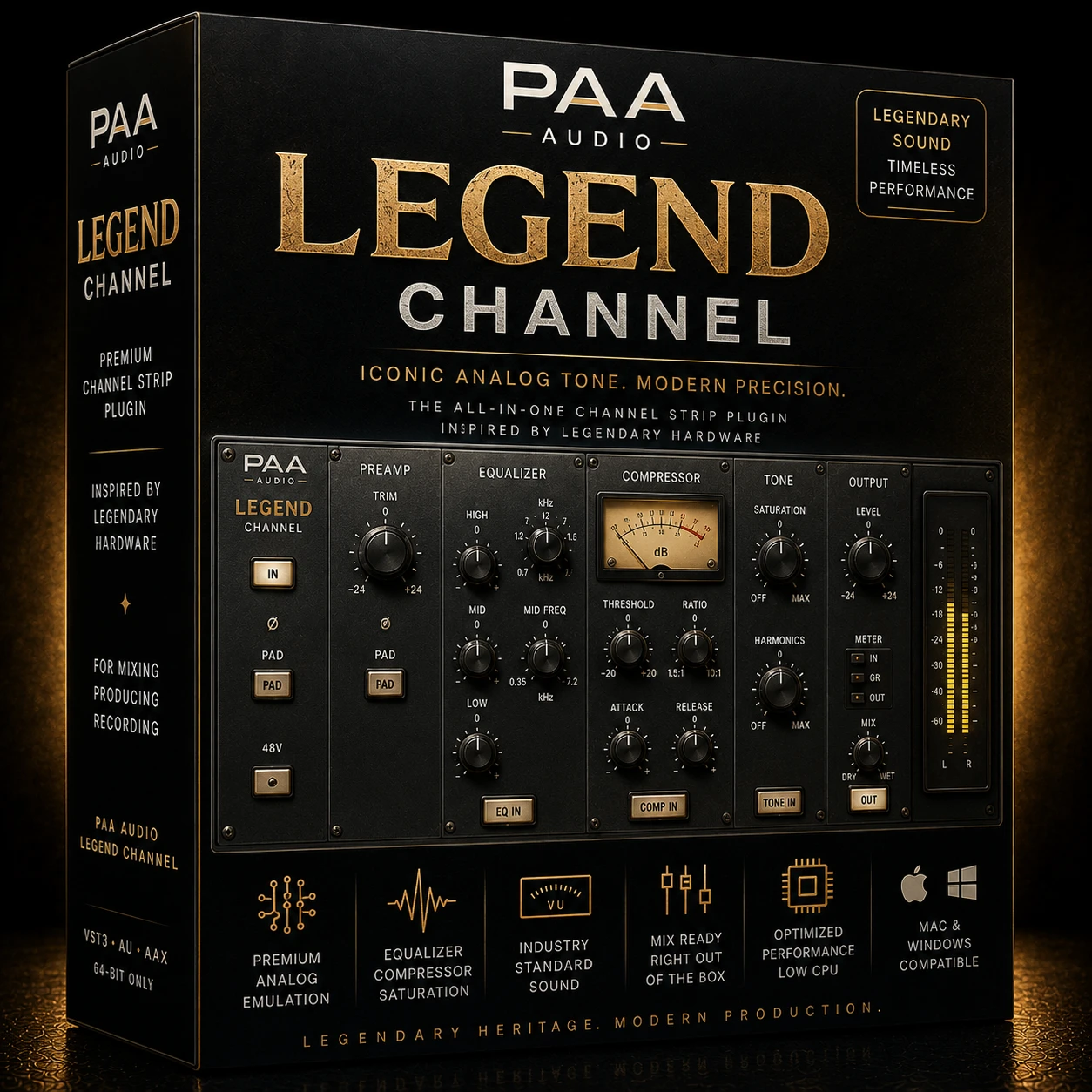
If you have spent years chasing that fat, forward, unmistakably “British console” sound inside your DAW, the PAA Audio Legend Channel is the 2026 release that finally gets you there without a rack, a patchbay, or a five-figure invoice. Released in July 2026 by German developer PAA Audio — a genuine one-developer operation — the Legend Channel is a complete circuit-level model of a legendary British console channel: mic/line preamp with input-transformer drive, 12 dB/oct high- and low-pass filters, a musical 4-band proportional-Q EQ, a full compressor, and a gate/expander, all in one strip.
What makes the PAA Audio Legend Channel different from the dozens of “analog” plugins already on your drive is the engine underneath. Instead of a fixed saturation curve, an impulse response snapshot, or a neural capture, PAA Audio’s PCCN™ engine solves the actual circuit — transformer magnetic hysteresis in real time, plus exact solutions of the real NE5534 and transistor/VCA stages taken from the original schematics. The result is emergent analog behavior: the plugin reacts differently at every gain and level setting, exactly like hardware does.
It runs natively on macOS, Windows and Linux as VST3, AU and AAX, with no iLok and no subscription, and it is currently at an intro price of $109 (regular $129). Full details are on the official PAA Audio website, and you can compare it against other channel strips at retailers like Plugin Boutique or Sweetwater.
3. Overview
The PAA Audio Legend Channel is a single-instance, full-path channel strip designed to sit first in the chain on every track you record or mix. Version 1.2.4 is the current build, and the plugin is deliberately narrow in scope: it does not try to be a mastering suite or a modular rack. It models one channel of a classic 1990s/2000s British console — the kind of desk that countless commercial records were tracked and mixed through — and it models it end to end.
Signal flow runs Input / Mic-Line select → transformer drive → HP/LP filters → 4-band EQ → compressor → gate/expander → output trim and fader, with a peak meter, preset system, and a resizable UI from 100% to 150%. The philosophy is honest to a fault: PAA Audio openly states on the product page that they do not license the original console name and will not invent celebrity endorsements — instead they ship a full demo and invite you to A/B it against whatever you already own.
For 2026, this positions the PAA Audio Legend Channel as the enthusiast pick: less marketing, more DSP, and a price that undercuts almost every subscription-bundled competitor.
4. Module-by-Module Breakdown
4.1 Mic/Line Preamp with Input-Transformer Drive
Features
- Switchable Mic/Line input staging with -30 dB pad
- Real-time solved transformer magnetic hysteresis (not a static curve)
- “Preamp Drive” gain-riding: push the iron harder without getting louder
- Level-dependent saturation and transformer bloom on transients
Hardware reference: the input stage of a classic British console channel amplifier, built around NE5534-class op-amp and transistor topology with a genuine input transformer. Circuit and device details are documented by PAA Audio.
Best for: vocals, DI bass, snare and room mics — anything that needs weight and forward presence before you touch EQ.
4.2 High- and Low-Pass Filters
Features
- 12 dB/octave high-pass and low-pass slopes
- Placed pre-EQ so you clean up before you shape
- Musical, gentle knees rather than surgical brick walls
Hardware reference: the console channel’s swept filter section, which engineers historically used as a first-pass cleanup before the EQ stage. See the module notes on the official Legend Channel page.
Best for: removing rumble from vocals and guitars, taming boomy rooms, and de-mudding dense arrangements.
4.3 Musical 4-Band EQ (HF / HMF / LMF / LF)
Features
- Four bands: HF, HMF, LMF, LF
- Shelf or bell selection on the outer bands
- Proportional-Q behavior — wide at small boosts, tighter at large ones
- Harmonically rich low band that adds density, not just level
Hardware reference: the inductor-flavored British console EQ that made this desk famous; PAA Audio models the stage from schematics rather than curve-matching, as described on the PAA Audio site.
Best for: broad tonal sculpting where you want the EQ to add character — vocal air, guitar bite, kick and bass weight.
4.4 Compressor
Features
- Ratio range extending up to limiting
- Auto-release and auto-gain options
- Exact-solution VCA stage for authentic “grab” and recovery
- Holds transients and stereo depth even at high gain reduction
Hardware reference: the console’s VCA-based channel dynamics section, modeled at device level per the Legend Channel technical notes.
Best for: lead vocals, bass, drum bus glue — users on Gearspace have singled it out as one of the most natural-sounding vocal compressors available in the box.
4.5 Gate / Expander
Features
- Range, hysteresis and duck controls
- External key (sidechain) input
- Expander mode for gentle downward shaping
Hardware reference: the channel gate/expander module of the original desk, retaining its punchy, analog-style attack. Documented by PAA Audio.
Best for: tightening drum shells, cleaning up guitar amp noise, and rhythmic ducking effects.
4.6 Output Section
Features
- Output trim plus channel fader
- Peak metering
- Preset browser and resizable UI (100–150%)
Hardware reference: the console channel output amplifier and fader path, completing the modeled signal chain described on the PAA Audio product page.
Best for: gain-staging drive-heavy settings and matching levels for honest A/B comparisons.
5. What’s Included
| Item |
Details |
| Plugin |
PAA Audio Legend Channel v1.2.4 |
| Type |
Full British console channel strip |
| Modules |
Mic/Line preamp, HP/LP filters, 4-band EQ, compressor, gate/expander, output |
| Engine |
PCCN™ circuit-level modeling |
| Formats (macOS) |
VST3, AU, AAX (notarized installer) |
| Formats (Windows) |
VST3, AAX (64-bit installer) |
| Formats (Linux) |
VST3 (tar.gz) |
| Presets |
Factory preset library included |
| Documentation |
Legend Channel User Manual (PDF) |
| Demo |
Full-feature demo mode with periodic noise burst |
| Licensing |
License file tied to name/email — no iLok, not machine-locked |
| Price |
$109 intro (regular $129), one-time |
6. Features Summary
- PCCN™ circuit modeling — solves the real schematic and device physics instead of approximating a result.
- Complete channel path — preamp, filters, EQ, compressor and gate in a single instance.
- Transformer drive with gain-riding — saturate the iron without volume jumps.
- Proportional-Q 4-band EQ with shelf/bell switching on the outer bands.
- VCA compressor with auto-release, auto-gain and ratio up to limiting.
- Gate/expander with range, hysteresis, duck and external key.
- Level-dependent behavior — response changes with drive and input level, like hardware.
- Cross-platform native — macOS, Windows and Linux, Apple Silicon Universal 2.
- No iLok, no subscription — one-time purchase, portable license file.
- Resizable UI from 100% to 150% with full preset management.
7. Main Highlights (5 Points)
- True circuit model, not a curve. PCCN™ solves transformer hysteresis and the actual NE5534/transistor VCA stages in real time — no tanh, no IR, no neural capture.
- One strip replaces a chain. Preamp, filters, EQ, compressor and gate in one window means faster mixes and lower CPU than stacking four plugins.
- It survives hard compression. Reviewers repeatedly note it does not pump, flatten the stereo image, or kill transients even at high gain reduction.
- Genuinely cross-platform. VST3/AU/AAX on Mac and Windows, plus first-class Linux VST3 support — rare in 2026.
- Honest, friction-free ownership. $109 intro price, full demo, no iLok, no subscription, and a license file tied to you rather than a machine.
8. Why Producers and Mix Engineers Choose the PAA Audio Legend Channel
Professional mixers choose the PAA Audio Legend Channel because it behaves like a piece of gear rather than a processor. When you push the preamp, the tone genuinely evolves — harmonic content shifts, low end thickens, and transients bloom instead of clipping into a fixed curve. That means the same plugin can be transparent at conservative settings and aggressively colored when driven, so you learn one interface and get an entire tonal range.
Mix engineers also choose it for workflow discipline. Instantiating one Legend Channel on every track gives you a consistent console-style starting point: filter, shape, control, gate — in that order, every time. That consistency is exactly what tracking engineers used to get from a physical desk, and it dramatically reduces decision fatigue on large sessions.
Finally, producers choose it for the economics and the ethics. There is no subscription, no iLok dongle, no machine authorization to break when you upgrade a computer, and PAA Audio’s own marketing refuses to fake celebrity credits. For a lot of 2026 buyers, that transparency — combined with a full unlimited-feature demo — is the deciding factor.
9. Professional Workflow Examples
Lead vocal (pop / R&B)
- Set input to Mic, engage the -30 dB pad, then raise Preamp Drive until the transformer just starts to thicken.
- High-pass at 80–100 Hz to remove rumble.
- LF shelf -1.5 dB to control proximity, HMF bell +2 dB around 3 kHz for intelligibility, HF shelf +2 dB for air.
- Compressor at 4:1, auto-release on, 4–6 dB gain reduction, auto-gain to level-match.
- Gate in expander mode with a shallow range to clean up headphone bleed between phrases.
Drum bus (rock)
- Line input, moderate drive for glue and transformer weight.
- Low-pass around 16 kHz to soften cymbal fizz.
- LF bell +2 dB at 60 Hz, HMF cut -1.5 dB around 500 Hz to open the midrange.
- Compressor at 2:1 with slower attack, 2–3 dB gain reduction for cohesion without pumping.
DI bass (any genre)
- Push Preamp Drive hard — this is where PCCN™ level-dependent saturation earns its price.
- High-pass at 30 Hz to protect the sub region.
- LMF bell +2 dB around 800 Hz so the bass reads on small speakers.
- Compressor at 4:1 with fast attack for consistent note-to-note level.
Tracking template (studio)
- Place one Legend Channel first in the chain on all inputs in your DAW template.
- Save a factory-plus-custom preset per source type (vocal, kick, snare, bass, guitar, room).
- Print with modest drive, keep heavier processing post-fader — the plugin’s honest metering makes gain-staging straightforward.
10. Best For
The PAA Audio Legend Channel is best for:
- Home and project studio producers who want one console-grade strip on every track instead of stacking four separate plugins.
- Mix engineers who need analog color that survives heavy compression without collapsing depth or stereo width.
- Vocal-focused producers in pop, R&B, hip-hop and singer-songwriter work — the compressor is widely praised for transient retention.
- Pro Tools users who need real AAX support on Mac and Windows without an iLok dongle.
- Linux-based studios, which almost never get commercial channel strips of this quality.
- Budget-conscious buyers who prefer a one-time $109 purchase over a subscription bundle.
It is less ideal for engineers who need surgical, fully transparent correction — a clean digital EQ is a better tool for notching resonances — or for anyone who wants modular per-module instances rather than one fixed console path.
Looking for free plugins? Browse our Free VST Downloads — updated regularly with the best free VST plugins available.
11. Supported Formats
| Platform |
Formats |
Notes |
| macOS |
VST3, AU, AAX |
Notarized installer, Universal 2 (Intel + Apple Silicon) |
| Windows |
VST3, AAX |
64-bit only |
| Linux |
VST3 |
Distributed as tar.gz |
| Not supported |
VST2, CLAP, standalone |
Channel strip is plugin-only |
Compatible with Pro Tools, Logic Pro, Ableton Live, Cubase, Studio One, FL Studio, Reaper, Bitwig, Digital Performer, Mixbus and other VST3/AU/AAX hosts.
12. System Requirements
macOS
- macOS 10.13 High Sierra or later (current releases recommended)
- Intel or Apple Silicon (Universal 2 binary)
- 64-bit VST3, AU or AAX host
- ~50 MB free disk space
- 4 GB RAM minimum, 8 GB+ recommended
Windows
- Windows 10 or later, 64-bit only
- 64-bit VST3 or AAX host
- ~50 MB free disk space
- 4 GB RAM minimum, 8 GB+ recommended
Linux
- Modern 64-bit distribution with a VST3 host
- tar.gz manual install
Authorization
- No iLok, no dongle, no subscription
- License file tied to the name and email used at checkout, not to a machine
- Internet connection needed only to download the installer and license file
13. FAQ
1. What is the PAA Audio Legend Channel?
It is a complete British console channel strip plugin containing a mic/line preamp with transformer drive, high/low-pass filters, a 4-band EQ, a compressor and a gate/expander, all modeled at circuit level.
2. Which console does it model?
PAA Audio does not license the original name, but describes it as a faithful circuit-level model of a legendary British console channel from the 1990s/2000s, built from the real schematics.
3. What is PCCN™?
PCCN™ is PAA Audio’s circuit-modeling engine. It solves the actual device equations — including transformer magnetic hysteresis and NE5534/transistor VCA stages — in real time, rather than applying a fixed saturation curve, an impulse response, or a neural approximation.
4. Does it work on both Mac and Windows?
Yes. macOS gets VST3, AU and AAX from a notarized installer; Windows gets 64-bit VST3 and AAX. Linux VST3 is also supported.
5. Does it support Apple Silicon?
Yes — the macOS build ships as a Universal 2 binary for both Apple Silicon and Intel Macs.
6. Do I need an iLok?
No. There is no iLok, no dongle and no subscription. You activate with a license file tied to your name and email, and it is not locked to a single computer.
7. Is there a free trial?
Yes. Download the installer and run it in Demo Mode, which is fully featured but plays a brief periodic noise burst. Clicking ACTIVATE with your license file removes it.
8. How much does it cost?
The intro price is $109, with a regular price of $129 — a one-time purchase, not a subscription.
9. Is it CPU-heavy?
Because it solves real circuit equations it is more demanding than a simple EQ, but it replaces four or five separate plugins in one instance, so a full channel path is typically comparable or lighter overall. Use buffer sizes of 256+ samples on large sessions.
10. Is it good on the mix bus?
It can work, particularly with gentle compression and modest drive, but it is designed as a per-channel strip. For dedicated bus glue, PAA Audio’s own bus compressor is the more targeted option.
14. Final Review + Rating
The PAA Audio Legend Channel is the most convincing single-developer channel strip release of 2026. The preamp and transformer stage are the standouts — drive genuinely changes tone rather than simply adding fizz — and the compressor deserves the praise it has been getting on forums for keeping transients and stereo depth intact at gain reduction levels where most in-the-box compressors start to collapse. The 4-band EQ is characterful rather than surgical, and the low band in particular adds a harmonic density that clean digital EQs cannot replicate.
The weak points are minor and mostly ergonomic. Switching from Line to Mic without engaging the pad produces a large level jump, which users have flagged as a usability issue worth fixing, and there is some bell warping at the very top of the EQ range. Neither affects the core sound quality. There is also no VST2 or CLAP support, which may matter for legacy or Bitwig-centric setups.
At $109 with no dongle, no subscription and genuine cross-platform support including Linux, it is exceptional value against subscription-bundled competitors. For broader industry context on console-strip modeling and mixing technique, see the coverage at Sound On Sound and Gearnews, and cross-shop pricing at Plugin Boutique or Sweetwater.
| Category |
Rating |
| Sound quality |
9.7 / 10 |
| Preamp & saturation |
9.8 / 10 |
| EQ |
9.3 / 10 |
| Dynamics (comp + gate) |
9.6 / 10 |
| Workflow & UI |
9.0 / 10 |
| Value for money |
9.8 / 10 |
| Overall |
9.5 / 10 — Highly Recommended |












 Download instantly from PluginsBoutique
 Instant Digital Delivery







Reviews
Clear filtersThere are no reviews yet.