Try our service free
→ Discover complimentary downloads without needing a payment method.
Browse free






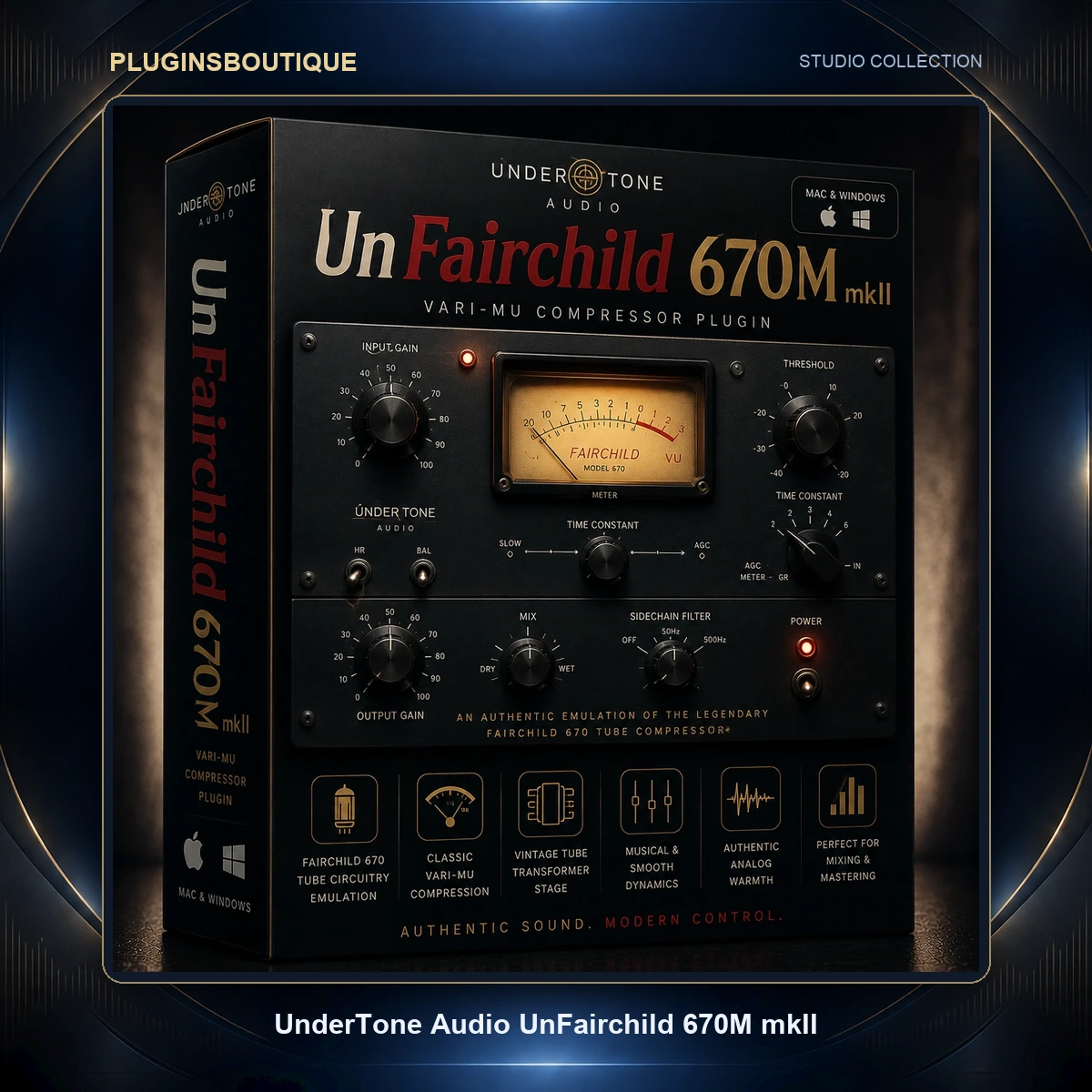


Overview
The Fairchild 670 is the most mythologised compressor ever built, and also one of the most awkward to actually use. Six preset time constants, a fixed detection topology, and a threshold behaviour that assumes 1950s console levels. Engineers work around these limitations because the sound justifies it, not because the design is convenient.
UnderTone Audio, run by Eric Valentine, built the UnFairchild 670M II as an answer to that. It is not a clone. The variable-mu tube circuit at the core follows Fairchild principles, but the surrounding control set was rebuilt: four continuously variable time constants were added alongside the six originals, the DC Threshold became user-adjustable so the unit could interface with modern as well as vintage gear, and the detector gained a switch between feed-back and feed-forward behaviour. Mid/side operation, sidechain processing and true bypass followed.
The UTA-D UnFairchild 670M mkII plugin, developed in partnership with MixLand, models that hardware. This matters for expectation-setting: compared against other Fairchild emulations it does not sound like them, because the machine it emulates does not sound like a stock 670 either.
Three software-only controls extend it further — makeup gain, wet/dry mix and an overall THD adjustment.
Why Choose This Plugin
Separating distortion from compression is the standout capability. On a real tube compressor, harmonic content is a by-product of how hard the tubes are driven, so wanting more colour means accepting more gain reduction. The THD control breaks that link, letting you take heavy compression with the character pulled back, or minimal gain reduction with the tube colour pushed forward. Neither is possible on the hardware.
Control depth is the second reason. Ten time constants — six preset, four variable — alongside an adjustable DC Threshold produce a range that reviewers have described as spanning the most delicate touch through to genuinely aggressive processing. The interaction between DC Threshold and the main threshold in particular changes the knee behaviour in ways a single-threshold design cannot reach.
Third, feed-back versus feed-forward detection provides two distinct compression personalities from one unit. Feed-back detection, the classic topology, reacts more gently and musically; feed-forward responds faster and more precisely.
Fourth, mid/side operation on the mix bus. Tape Op’s review specifically noted the M/S settings producing a marked widening effect while tightening low-frequency focus — a use case that pure emulations of the original cannot offer, since the 670 had no such mode.
Key Features
- Variable-mu tube compression modelled on UTA’s UnFairchild 670M II hardware rather than the original Fairchild 670.
- Six preset time constants carried over from the classic design.
- Four variable time constants with continuously adjustable attack and release.
- User-adjustable DC Threshold, interacting with the main threshold to reshape compression behaviour.
- Feed-back and feed-forward detection modes for two different compression characters.
- Mid/side operation for independent processing of centre and sides.
- Sidechain processing, allowing the detector to be triggered by a filtered or external signal.
- Fine left/right balance adjustment as on the hardware.
- True bypass for unbiased A/B comparison.
- Overall THD control — software-only; increases or decreases UnFairchild-style harmonic character independently of gain reduction.
- Wet/dry Mix control — software-only; enables parallel compression without routing.
- Post-compression makeup gain — software-only; quick level compensation.
What’s Included
Purchase provides the UTA-D UnFairchild 670M mkII plugin in all supported formats for both platforms, with the developer’s support manual as a PDF. UnderTone Audio has offered a 14-day trial so the plugin can be evaluated on real sessions.
Point releases within the version line have been issued since launch, and UnderTone Audio maintains a support documentation page covering both the plugin and the hardware it models.
System Requirements
UnderTone Audio publishes explicit minimums:
- Processor: 1 GHz Intel Dual Core or AMD equivalent on PC
- RAM: 4 GB
- macOS: OS X 10.7 or higher, with 10.14 or higher recommended
- Windows: Windows 7 and above
- Display: 1024 x 768 or higher
- Host: 64-bit DAW support only
- Mac formats: VST3, AU and AAX, 64-bit with native Apple Silicon support
- Windows formats: VST3 and AAX, 64-bit
These are notably modest figures for a tube emulation, and the 4 GB RAM floor reflects that this is a single processor rather than a sample library. There is no AU on Windows and no VST2 listed on either platform, so hosts requiring VST2 will need an alternative.
Installation Guide
- Download the installer for your platform from the UnderTone Audio digital store.
- Run the installer and select the formats your hosts require — VST3, AU or AAX on Mac; VST3 or AAX on Windows.
- Complete authorisation using the licence details supplied with your purchase.
- Launch your DAW and rescan plugin folders if the plugin does not appear. Confirm the host is running 64-bit, since 32-bit hosts are not supported.
- Download the support manual PDF from UnderTone Audio before the first session.
A practical suggestion for getting oriented: engage true bypass and A/B repeatedly while setting the DC Threshold. That control has no equivalent on most compressors and its effect is easier to hear by comparison than to predict from the panel.
Compatibility
Format coverage suits professional rooms. AAX means native Pro Tools support; AU covers Logic Pro; VST3 handles Cubase, Ableton Live, Studio One, Reaper, FL Studio and Bitwig. Apple Silicon Macs run the plugin natively.
Owners of the UnFairchild 670M II hardware occupy a specific position here: the plugin reproduces the same control set, so settings and recall sheets translate conceptually between the two. UnderTone Audio publishes a hardware recall sheet alongside the plugin manual.
Who Is This Plugin For?
- Vocal engineers. Reviewers have singled out vocals as where this compressor is most convincing, adding energy and weight rather than merely controlling level.
- Mix bus and mastering engineers wanting variable-mu glue with M/S control over how that glue is applied across the stereo field.
- Drum bus engineers, where variable-mu behaviour is traditionally strong and the variable time constants allow tuning to the specific kit.
- Engineers who find stock Fairchild emulations too restrictive, since the additional time constants and DC Threshold address exactly those limits.
- UnFairchild hardware owners needing consistent processing when working away from the rack.
Anyone wanting a period-accurate 1959 Fairchild 670 should be clear that this is not that plugin. It models a modernised descendant, and the differences are deliberate.
Workflow Benefits
Parallel compression stops requiring a routing setup. On hardware, blending compressed and uncompressed signal means a send, a return, and phase alignment between them. The Mix control collapses that into one knob on one insert, which in practice means parallel processing gets tried on sources where the routing overhead would previously have discouraged it.
Independent THD adjustment also resolves a recurring conflict. Dense mixes often need the compression but not the accumulated harmonic content, particularly when several tube emulations are stacked across a session. Pulling THD back while keeping the gain reduction is a decision that simply cannot be made on the physical unit.
Makeup gain speeds up honest comparison. Louder reliably sounds better, so evaluating a compressor without level matching produces bad decisions. Having compensation built into the plugin makes the level-matched A/B the default rather than an extra step.
Frequently Asked Questions
1. Is this an emulation of the original Fairchild 670?
No. It models UnderTone Audio’s UnFairchild 670M II hardware, which reworks the Fairchild circuit with additional controls. It sounds different from stock 670 emulations by design.
2. Who developed the plugin?
UnderTone Audio in partnership with plugin developer MixLand.
3. What is variable-mu compression?
A tube-based topology where the gain reduction is produced by the tube’s own changing characteristics, giving smooth, program-dependent behaviour.
4. How many time constants are there?
Six preset time constants from the classic design, plus four variable ones with adjustable attack and release.
5. What does the DC Threshold control do?
It adjusts the threshold reference so the unit interfaces correctly with different signal levels, and its interaction with the main threshold significantly alters compression behaviour.
6. What is the difference between feed-back and feed-forward?
Feed-back detection samples the output and reacts more gently; feed-forward samples the input and responds faster and more precisely.
7. What does the THD control do?
It raises or lowers the amount of UnFairchild-style harmonic distortion independently of the compression, separating colour from gain reduction.
8. Can I do parallel compression inside the plugin?
Yes, via the wet/dry Mix control, with no external routing required.
9. Which hardware controls are missing?
Gain Trim, Balance and the GR Zero meter scale adjustment, none of which serve a purpose in software. Everything else is reproduced.
10. Does it support mid/side processing?
Yes, and reviewers have highlighted M/S on the mix bus as one of its strongest applications.
11. What formats are available?
VST3, AU and AAX on macOS; VST3 and AAX on Windows. All 64-bit.
12. Does it work on Apple Silicon?
Yes, the macOS build is M-series native.
13. Will it run on a 32-bit host?
No. Only 64-bit DAWs are supported.
14. Is there a sidechain input?
Yes. Sidechain processing allows the detector to be driven by a filtered or external signal.
Conclusion
The interesting decision behind this plugin was choosing what to model. Emulating the 1959 Fairchild 670 would have put it in a crowded field competing on accuracy. Modelling UTA’s rebuilt version instead produces a compressor with a genuinely different control surface — ten time constants, adjustable DC Threshold, switchable detection topology, M/S — that happens to share the variable-mu tube character everyone wants from the lineage.
Add three controls the hardware physically cannot provide, and the THD control in particular, and the result is a tube compressor that behaves like a modern tool while still sounding like a valve unit under load.
Related dynamics processors are grouped under Mix & Master Plugins, and larger processing collections under Plugin Bundles. The manual, specifications and trial are available from the developer at digital.undertoneaudio.com.






Reviews
Clear filtersThere are no reviews yet.