Try our service free
→ Discover complimentary downloads without needing a payment method.
Browse free






Overview
Plugin catalogues tend to be organised around hardware history. Buy a bundle from most developers and you receive a console strip, a tube compressor, a tape machine, a plate reverb — the same twelve devices every manufacturer has already modelled, differing mainly in the quality of the modelling.
Lese does not work that way. The company describes its output as boutique sound tools, and the catalogue reads accordingly: Fletcher is a temporal smoother, Hikari is a stochastic reverb, Slice is a multi slicer, Codec is a degradation processor built around internet compression codecs rather than analog media, and Eigen simulates early reflections while analysing room resonances and rendering impulse responses. These are concepts first and products second.
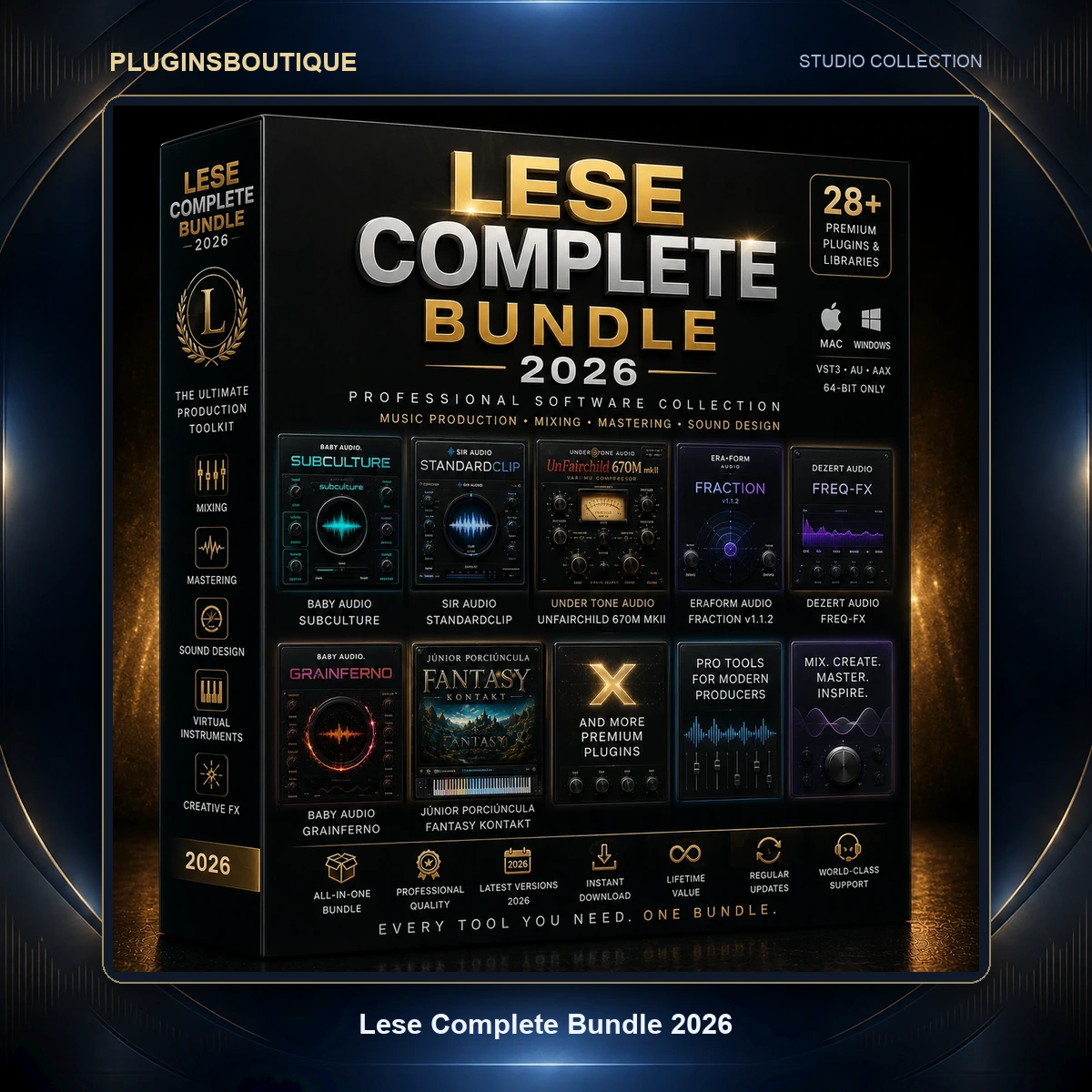
The Complete Bundle gathers the entire lineup. The developer’s own categorisation spans delay, distortion, granular, modulation, reverb, spatial and spectral processing, and the bundle covers all of it. Every plugin is available on macOS and Windows in VST3, AU and AAX.
One structural detail sets this apart from most bundle offers: it is not a snapshot of the catalogue at purchase time. Buying it entitles the owner to all future releases, with licence keys issued automatically as new plugins ship.
Why Choose This Bundle
The future-releases term is the strongest commercial argument. Most bundles freeze at what existed on the day of purchase, and the next release costs extra. Lese generates keys for new products automatically for bundle owners, which converts a one-time purchase into ongoing catalogue access. For an active developer, the value of that grows rather than depreciates.
Originality is the artistic argument. When every developer models the same 1176, choosing between them means comparing accuracy. Lese’s tools have no direct equivalents, so the comparison is not against a rival emulation but against not having the capability at all. Codec in particular addresses something real and largely unaddressed — the degradation most listeners actually encounter today is codec artefacting, not tape hiss, and almost nobody builds a plugin around that.
Third, the underlying engineering is shared rather than superficial. The Impulse Engine developed by Lese powers Eigen’s early-reflection simulation and has been licensed to other developers, including AudioThing’s Fog Convolver 2. That is a meaningful signal about the quality of the DSP.
Fourth, format coverage is consistent. Everything runs VST3, AU and AAX on both platforms, so there are no gaps in the collection depending on which host you use.
Key Features
- The complete Lese catalogue — every plugin the developer has released, in one licence.
- All future releases included — licence keys are generated automatically for new products as they ship.
- Codec — degradation via real internet compression algorithms, compressing and decompressing audio in real time; now at version 2 with expanded controls.
- Hikari — stochastic reverb, using probabilistic behaviour rather than fixed reflection patterns.
- Fletcher — temporal smoother, operating on the time domain in a way no hardware analogue provides.
- Slice — multi slicer for rhythmic fragmentation and rearrangement.
- Eigen — early-reflection simulation, room resonance analysis and impulse response rendering, built on the Impulse Engine.
- Sweep, Frahm, Teuri, Glow and further tools across the catalogue.
- Seven processing categories — delay, distortion, granular, modulation, reverb, spatial and spectral.
- VST3, AU and AAX for macOS and Windows across the entire range.
What’s Included
The bundle provides licences for every plugin currently in the Lese catalogue, in all three formats for both operating systems, plus automatic entitlement to future products. Because the contents expand over time, the exact list at any moment is best checked on the developer’s own bundle page.
Lese also distributes certain plugins free of charge, including Codec and Sweep, so it is possible to evaluate the developer’s approach before committing to the full collection.
System Requirements
Lese states its requirements at the catalogue level rather than per plugin:
- Operating systems: macOS and Windows
- Formats: VST3, AU and AAX — note that VST2 is not part of the lineup
- Architecture: 64-bit hosts
- A modern multi-core processor; spectral and granular tools are the more demanding entries in the range
- 8 GB RAM or more as a practical baseline
- Modest disk space — these are algorithmic processors, not sample libraries
The absence of VST2 is the one thing to verify against your setup. Hosts that only accept VST2 will not load these plugins, and AAX availability makes Pro Tools a supported target instead. Exact minimum OS versions are published per plugin on the developer’s site.
Installation Guide
- Sign in to your Lese account, where the downloads page lists every plugin your licence covers.
- Download the installers you want — the plugins install individually rather than as a single package, so you can install only what you intend to use.
- Run each installer and select the required formats.
- Enter the licence key generated for that plugin on first launch.
- Rescan plugin folders in your DAW if any entry fails to appear.
- Return to the account downloads page after new releases — keys for new products appear there automatically for bundle owners.
Because the catalogue grows, it is worth checking the account page periodically rather than waiting for an announcement. Plugins you already own licences for may be sitting there undownloaded.
Compatibility
VST3, AU and AAX across macOS and Windows covers Ableton Live, Logic Pro, Cubase, Studio One, Reaper, FL Studio, Bitwig and Pro Tools. Pro Tools users are properly served through AAX, which not every boutique developer bothers with.
Worth flagging separately: the Impulse Engine that underpins Eigen is also licensed into third-party products, so anyone already running AudioThing’s Fog Convolver 2 is using a version of the same technology. The processing philosophy carries between them.
Who Is This Bundle For?
- Sound designers who have exhausted conventional processing and need tools built on unfamiliar premises.
- Experimental and electronic producers working with texture, degradation and spectral manipulation as compositional material.
- Lo-fi and hyperpop producers, for whom Codec’s internet-compression degradation is closer to the intended aesthetic than any tape emulation.
- Engineers investigating room acoustics, where Eigen’s resonance analysis and impulse response rendering have genuine diagnostic value.
- Anyone who buys catalogues rather than individual plugins, since the future-releases entitlement compounds over time.
A mix engineer looking to assemble a conventional channel strip will not find one here. The catalogue deliberately avoids that territory, and buying it expecting console emulations would be a mismatch of purpose.
Workflow Benefits
Owning the full catalogue changes how the tools get used. When a plugin costs money, it gets loaded only when the need is already identified — which means the unusual processors never get tried, because nobody buys a temporal smoother speculatively. With everything installed, the experimental tools enter the workflow simply because they are there.
Shared design language across a single developer’s range also reduces learning time. Interface conventions, parameter behaviour and modulation approaches carry between products, so the fifth Lese plugin takes considerably less time to understand than the first.
The automatic-key arrangement removes a decision that otherwise recurs indefinitely. Every new release from a developer you like normally prompts an evaluation of whether it is worth the money. Here new tools simply appear in the account, and the only question left is whether they suit the track.
Frequently Asked Questions
1. What does the Complete Bundle contain?
Every plugin Lese has released, across delay, distortion, granular, modulation, reverb, spatial and spectral categories.
2. Do I get plugins released after I buy?
Yes. Bundle ownership entitles you to all future releases, and licence keys are generated automatically as new products ship.
3. What is Codec?
A degradation plugin that compresses and decompresses audio in real time using internet compression algorithms, rather than emulating vinyl, tape or cassette.
4. What is a stochastic reverb?
Hikari generates reflections using probabilistic rather than fixed patterns, producing reverb behaviour that differs from conventional algorithmic designs.
5. What does Fletcher do?
It is a temporal smoother, operating on audio in the time domain — a category with no hardware precedent.
6. What is Eigen used for?
Simulating early reflections, analysing room resonances and rendering impulse responses, using a simplified version of Lese’s Impulse Engine.
7. Which formats are supported?
Every plugin ships as VST3, AU and AAX, on Mac and on Windows alike.
8. Is there a VST2 version?
No. VST2 is not part of the lineup, so confirm your host supports VST3, AU or AAX.
9. Does it work in Pro Tools?
Yes, via AAX.
10. Can I try any plugins before buying the bundle?
Lese offers some plugins free of charge, including Codec and Sweep, which give a fair sense of the developer’s approach.
11. Do the plugins install as one package?
No, they install individually, so you can choose which to put on any given machine.
12. What is the Impulse Engine?
Lese’s acoustic simulation technology, used in Eigen and licensed to other developers including AudioThing for Fog Convolver 2.
13. Are these emulations of hardware?
No. The catalogue is built around original processing concepts rather than models of existing equipment.
14. Where do I find my downloads?
In your Lese account downloads area, which lists every plugin your licence covers and updates as new products are released.
Conclusion
Two things make this collection worth considering. The first is that the tools inside it cannot be substituted — there is no competing temporal smoother to compare against, and Codec’s approach to degradation has essentially no rivals. The second is structural: entitlement to everything the developer releases in future turns the purchase into a standing relationship with the catalogue rather than a fixed set of files.
Neither of those arguments applies to a conventional bundle of console and compressor emulations, which is precisely why this one is easier to justify for producers whose work depends on sounding unlike everyone else.
Additional processing collections appear under Plugin Bundles, with individual effects under Mix & Master Plugins. The current catalogue list is maintained by the developer at lese.io.





Reviews
Clear filtersThere are no reviews yet.