Try our service free
→ Discover complimentary downloads without needing a payment method.
Browse free






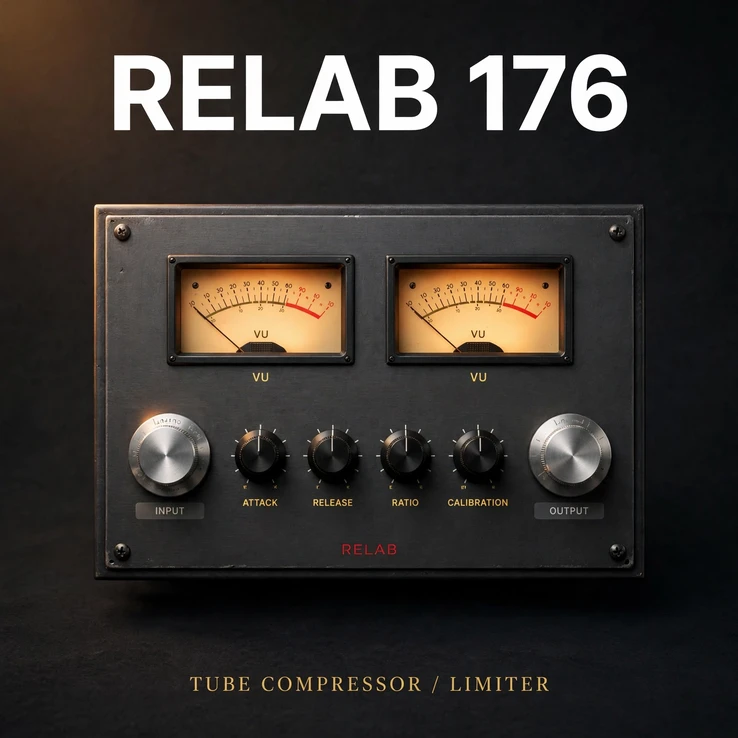


Relab 176 is a compressor/limiter plugin modelled from the entire audio circuit of a vintage 1960s 176-style compressor. Relab Development re-created every tube, transformer, timing network and power supply interaction using a real-time circuit solver, so the plugin preserves the tone, timing and dynamic behaviour of the original hardware instead of approximating it with static curves. What you hear is the whole circuit working together: tubes saturating, transformers shaping the frequency response, and the power supply sagging and recovering under sustained gain reduction.
The original 176 used a fixed-threshold, variable-gain topology, and Relab 176 follows the same design. Ratio, drive and the source material itself interact to shape the timing, the curve and the harmonics, so the compression adapts to the music instead of sitting on top of it. Turn the input up and the sound gets denser, warmer and more assertive; back it off and the same setting levels gently. It is a compressor you play, not just set.
Four hardware ratios in Relab 176
Relab 176 gives you the four hardware ratios of the original: 2:1, 4:1, 8:1 and 12:1. Each ratio changes the knee and the slope of the compression curve, so the character of the compression changes with the setting rather than simply getting stronger. At 2:1, Relab 176 smooths and levels with a soft touch that suits vocals and bass. At 4:1 and 8:1 it grips transients and glues a mix together. At 12:1 it behaves as an assertive limiter that holds peaks firmly in place. Because the knee position shifts with the ratio, every setting feels like a different shade of the same hardware rather than a different plugin.
This ratio-driven behaviour is what makes Relab 176 so musical on real sources. A vocal that needs gentle evening-out, a drum bus that needs punch and weight, and a mix bus that needs glue can all be served by the same plugin, simply by choosing the ratio that fits the job and driving the input to taste.
Program-dependent timing from real tube interaction
Attack and release in Relab 176 emerge from resistor-capacitor networks directly coupled to the tube gain stage, exactly as in the hardware. Timing is program-dependent: it is shaped by signal level, transient size, tube nonlinearity and transformer interaction, not by fixed millisecond values. A loud transient is caught differently from a quiet passage, and the release breathes with the performance.
The Fixed/Auto toggle changes how the release responds to the program material, giving you a further way to match the timing to the source. The result is compression that follows the music — pumping that feels intentional on drums, levelling that feels invisible on vocals, and a mix bus that moves as one.
Shape tone with coupling, polarity and calibration
Relab 176 adds three powerful tone-shaping tools that come straight from the hardware’s own circuit. Polarity-selective detection lets you choose whether the sidechain responds to the positive, negative, or both halves of the waveform, so you can target specific transient edges — a kick drum’s attack, or a vocal plosive — instead of compressing everything the same way.
The stage coupling switch selects between two authentic circuit paths. The Transformer path gives faster attack and added character, with a slight smile curve that flatters the top and bottom. The Resistor path gives slower attack, a flatter tone and a vintage low-end thump. Switching between them is an instant tone change, like re-patching the hardware.
Calibration moves the internal tube bias and balance together, shifting threshold, harmonic profile and dynamic feel in a single move — just like adjusting several trim pots on the original unit at once. Click the Relab logo to reveal the finer controls: three hardware-style trim pots for 6BC8 bias, 6BC8 anode balance and 12AX7 bias, plus a Reference Level control for gain staging. Together they let you fine-tune harmonic balance and transient response with the precision of a technician inside the original box.
System requirements for Relab 176 on Mac
Relab 176 for Mac requires macOS 10.15 (Catalina) or higher and an Apple Silicon M1 processor or newer. At least 8 GB of RAM is required, with 16 GB or more recommended. The plugin runs in AU, VST3 and AAX formats, all 64-bit. Compatible hosts, in their Apple Silicon-native versions, include Pro Tools 2020.11 and up, Cubase 9.5 and up, Nuendo 8 and up, Ableton Live 10 and up, and Reaper 7 and up. Authorisation uses a free PACE iLok account: no hardware dongle is required, and you can authorise on your computer directly or on an iLok USB key (version 2 or above). A free iLok account, an internet connection and the latest PACE drivers are required at the time of activation. This listing is for Mac only; there is no Windows version in this listing.
Frequently asked questions about Relab 176
Does Relab 176 work on Mac only? Yes. This listing is Mac only, for Apple Silicon Macs running macOS 10.15 or higher, in AU, VST3 and AAX formats.
Does Relab 176 need an iLok dongle? No. A free iLok account is required, but no hardware dongle is needed. You can authorise on your computer or on an iLok USB key (version 2 or above).
Which hardware does Relab 176 model? Relab 176 models the entire audio circuit of a vintage 1960s 176-style compressor — every tube, transformer, timing network and power supply interaction — solved in real time.
What do the four ratios change? Each ratio — 2:1, 4:1, 8:1, 12:1 — changes the knee and slope of the compression curve, taking you from smooth leveling to assertive limiting, with the fixed-threshold, variable-gain design intact.









Reviews
Clear filtersThere are no reviews yet.