Try our service free
→ Discover complimentary downloads without needing a payment method.
Browse free





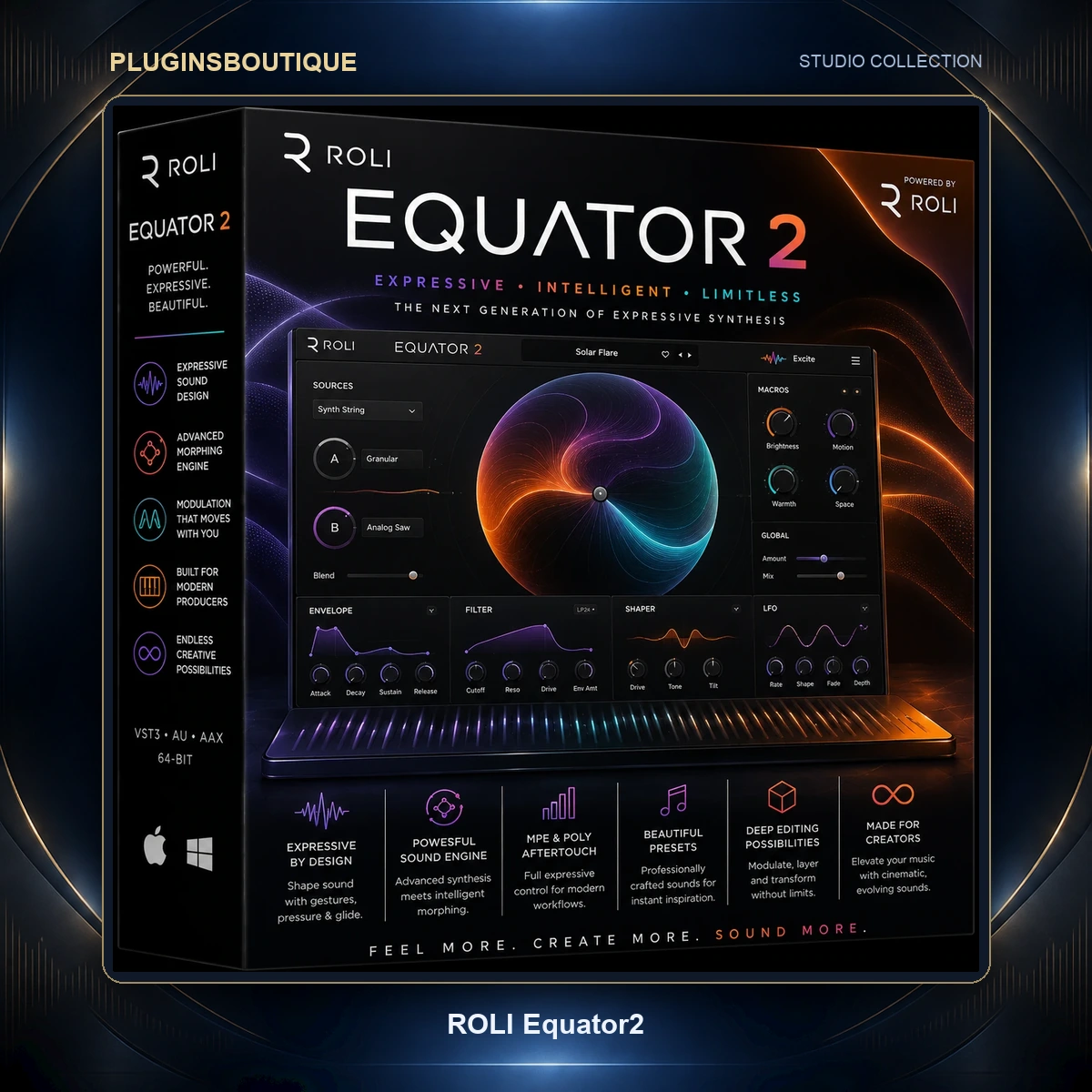


Meet a Synthesizer Designed for Expression
Most synthesizers are built around knobs, keys and conventional modulation.
ROLI Equator2 takes a much more expressive approach.
At its heart is a flexible hybrid synthesis architecture designed to respond to detailed performance gestures. With MPE, movements such as strike, glide, slide, press and lift can become part of the sound itself, allowing individual notes to respond independently.
That makes Equator2 particularly interesting for producers and musicians who want sounds that move, react and evolve while they are being played.
Six Source Modules. Four Synthesis Modes.
Equator2’s architecture gives you six Source Modules that can each operate as an:
- Oscillator
- Sampler
- Granular engine
- Noise engine
The Oscillator mode includes wavetable and virtual-analog capabilities, while the granular engine can transform samples into detailed microscopic textures. The sources can then be routed through Equator2’s flexible signal architecture.
This opens up an enormous range of combinations.
You can combine conventional synthesis with samples, granular processing and noise inside the same instrument rather than treating each technique as a separate workflow.
Sound Design Without Limits
The real strength of Equator2 is how its different systems interact.
A sound can begin with an oscillator, incorporate a sample, pass through granular processing, move through filters and then be transformed by modulation and effects.
That means Equator2 is equally at home creating:
- Expressive leads
- Deep basses
- Evolving pads
- Cinematic textures
- Atmospheric soundscapes
- Experimental sequences
- Organic electronic sounds
- Granular textures
- Hybrid instruments
- Complex evolving patches
MPE Turns Every Note Into a Performance
This is where Equator2 becomes particularly different.
ROLI’s MPE system allows expression to be applied per note, rather than treating the entire performance as one global MIDI gesture. ROLI describes MPE as enabling individual notes to respond independently to pitch movement, pressure and other gestures.
Equator2’s MPE inputs include:
Strike — note-on velocity
Glide — polyphonic pitchbend
Slide — polyphonic Y-axis control
Press — polyphonic pressure
Lift — note-off velocity
The result is a much more interactive relationship between performer and synthesizer.
A chord does not have to behave like a static block of notes.
Each note can become part of the performance.
A Modulation System Built for Movement
Equator2 is not limited to a couple of LFOs and envelopes.
Its modulation architecture includes five envelopes, five LFOs, two Multi-Mod sources, four Keytracking sources, four Math Modifiers, Random sources and expression-based modulation.
The Multi-Mod system is especially interesting for evolving sounds because it combines LFO-like and multi-stage envelope behavior and allows custom curves to be created.
This makes it possible to design patches that continuously change rather than simply triggering the same sound every time you press a key.
A 12-Slot Effects Environment
Equator2 also includes a semi-modular effects rack with 12 slots and multiple routing configurations. ROLI’s documentation lists 15 effects, covering dynamics, EQ, distortion, filtering, chorus, flanger, phaser, delays and reverbs.
The effects can be arranged through different routing structures, including mixed, parallel and feedback configurations.
That means the effects section isn’t simply an afterthought.
It becomes another part of the sound-design architecture.
Why Equator2 Stands Out
There are thousands of software synthesizers available today.
What makes Equator2 interesting is the combination of:
Hybrid synthesis + deep modulation + extensive effects + MPE expression.
Rather than focusing exclusively on recreating one particular vintage instrument, Equator2 is designed as an expressive sound-design environment.
It is particularly compelling when you want a synthesizer to behave more like a musical instrument than a static preset player.
Perfect for Modern Sound Design
Equator2 can fit into a huge variety of production styles.
Electronic Music
Build evolving sequences, expressive leads, deep basses and unusual textures.
Ambient
Create slow-moving pads and organic evolving soundscapes.
Cinematic
Combine granular sources, modulation and effects for atmospheric sound design.
Experimental Music
Push the synthesis architecture into unusual and unpredictable territory.
Pop & Contemporary Production
Add expressive synth layers that react naturally to performance.
Sound Design
Build complex patches that evolve continuously rather than remaining static.
Key Features
- Six flexible Source Modules
- Oscillator mode with wavetable and virtual-analog synthesis
- Sampler engine
- Granular synthesis engine
- Noise engine
- Advanced routing architecture
- Individual source filtering
- Two global filters
- 12-slot semi-modular effects rack
- 15 effects modules
- Five envelopes
- Five LFOs
- Two Multi-Mod sources
- Four Keytracking sources
- Four Math Modifiers
- Multiple Random modulation sources
- Deep MPE expression support
- Polyphonic pitch, pressure and slide control
Who Is ROLI Equator2 For?
Equator2 is especially appealing to:
- Electronic music producers
- Sound designers
- Film composers
- Ambient producers
- Experimental musicians
- Synth enthusiasts
- MPE controller users
- ROLI Seaboard users
- Producers who enjoy deep modulation
- Musicians looking for expressive software instruments
Frequently Asked Questions
What is ROLI Equator2?
ROLI Equator2 is a hybrid synthesizer focused on flexible sound design, deep modulation and expressive MPE performance.
Does Equator2 support MPE?
Yes. MPE is a central part of Equator2’s expressive workflow, with controls including Strike, Glide, Slide, Press and Lift.
How many synthesis sources does Equator2 have?
Equator2 has six Source Modules. Each can operate in Oscillator, Sampler, Granular or Noise mode.
Is Equator2 only for ROLI hardware?
No. ROLI documents both MPE and Standard MIDI modes, so the instrument can work within different MIDI workflows.
What makes Equator2 different from a traditional synthesizer?
Its combination of hybrid synthesis, extensive modulation, flexible routing, effects and per-note MPE expression makes it particularly suited to evolving and highly expressive sound design.






Reviews
Clear filtersThere are no reviews yet.