Try our service free
→ Discover complimentary downloads without needing a payment method.
Browse free






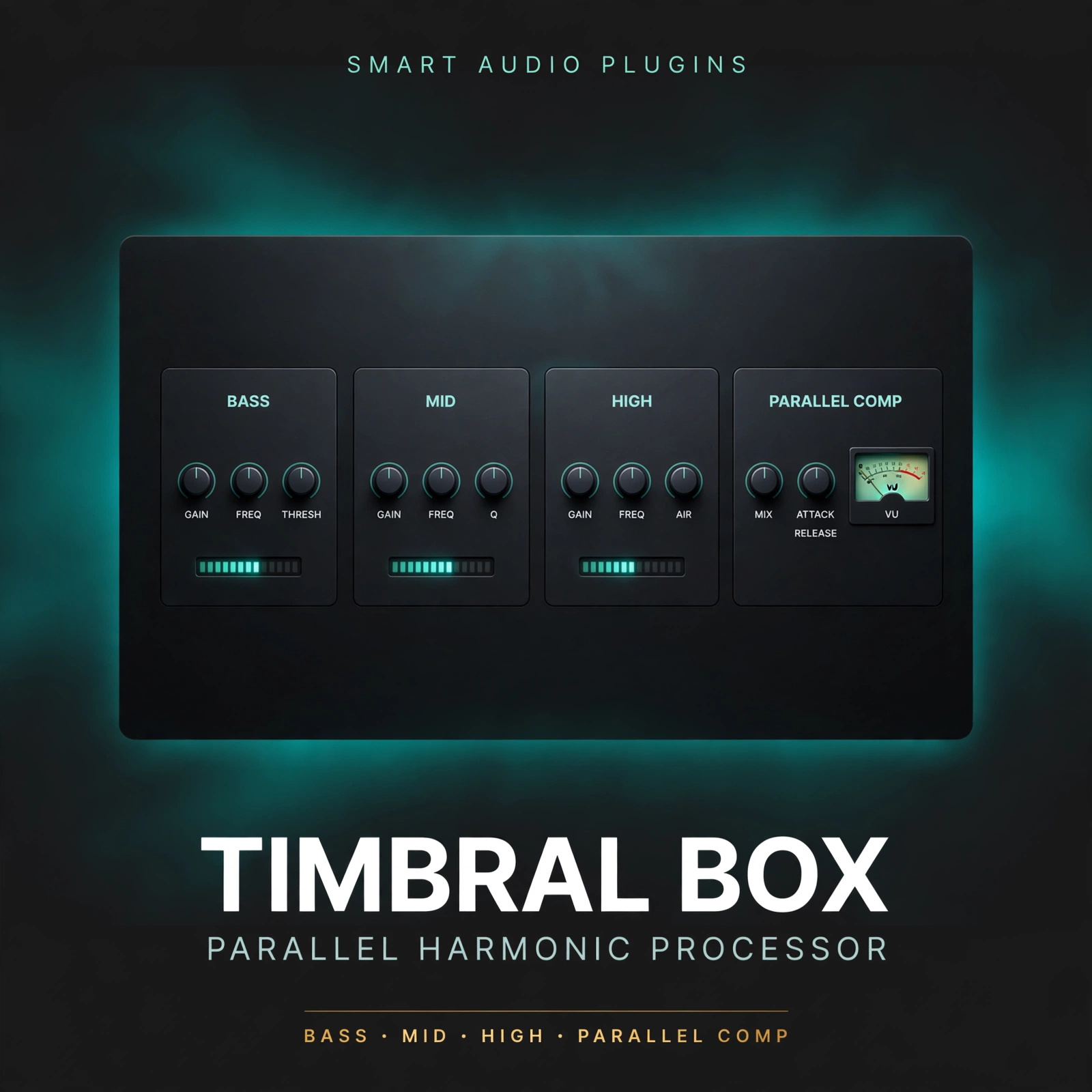


Smart Audio Plugins Timbral Box is a parallel harmonic processor for mixing and mastering that adds presence, weight and loudness without ever touching your dry signal. Made in Italy by Smart Audio Plugins, Timbral Box raises RMS and LUFS through musical harmonic saturation rather than compression, with a tape-style character that keeps transients and punch intact. Instead of running the whole signal through EQ, saturation and compression, it leaves the original untouched and adds four processed layers alongside it: Bass, Mid, High and Parallel Comp.
The idea is simple and radical at once. We all want volume and the perception of a present sound, but that usually costs too much compression. Timbral Box creates presence, emphasises the sound and, if you want it, adds compression — all in parallel, through harmonics. What you hear as more bass or more presence is harmonics sitting next to the sound, not EQ or compression applied to the sound itself. The choices you made in the mix, and the character of each instrument, stay exactly where they were.
Harmonics as a volume control
Think of harmonics as a volume control. Each section of Timbral Box introduces, in parallel, not only harmonics but also a portion of the signal filtered differently across three bands. The process behind the scenes is very dynamic and musical, and it varies from section to section — so the result never sounds like a static effect pasted over the mix. A vocal gains body and forwardness, a drum bus gains weight and movement, a full mix gains density and glue, and none of it sounds squeezed.
Because the dry signal passes through untouched, Timbral Box is unusually forgiving. Push a section hard and the worst that happens is more colour, not a damaged source. Pull it back and the effect melts into the mix. That makes it a tool you reach for on finished-sounding material as well as on problem tracks: it finishes mixes, rebalances spectra and adds the last few percent of perceived loudness that mastering usually chases with a limiter.
Four parallel layers: Bass, Mid, High and Parallel Comp
The Bass Processor works around four switchable centres — 34, 55, 89 and 144 Hz — chosen by ear and following the Fibonacci sequence. Its Bass Shape control is the first parameter to experiment with: turned counterclockwise the bass becomes freer, the transient stays open and the harmonics resonate longer, giving the low end more depth; turned clockwise the effect is tighter and more solid.
Phase can be set to Natural or Linear per section, and the Bass section offers two saturation modes.
The Mid Processor is the busiest area, and for good reason: it can significantly improve or worsen a sound, so it rewards careful listening.
Blend, Mid Focus and Mid Frequency reshape the tonal centre of the harmonics, Mid Shape compresses or lengthens the sound, and the 3D control adds depth without altering phase. The High Processor adds air and sparkle in parallel through Hi Shape and Hi Sparkle — a control to use with caution, since ears adapt to extra top end quickly. The Parallel Comp section is not a classic compressor: its Movement control drives both threshold and curve, and with Release it creates musical movement around the source while keeping transients intact.
Two saturation models: A and B
Every processor in Timbral Box offers two saturation models. Model A is the less distorted model, more oriented toward clipping — lighter, more open, and sometimes all a sound needs. Model B combines clipping and saturation for denser, more compact harmonics that dynamically interact with the Shape parameter. There are no rules about which to choose: A gives transparency and air, B gives density and glue, and the right answer changes with the material. Switching models on the same settings gives you two genuinely different sounds from one plug-in.
The Mid section makes the difference especially clear. Start from the recommended starting point — Sat Mode A with Blend at 0% — and the processor acts as a pure parallel equaliser, adding subtle midrange presence without any particular tone. Raise Blend and the harmonic curve of algorithm A starts to shape the sound; switch to Model B and the midrange thickens. It is a fast way to learn what each model does, and a reliable starting point for any new mix.
Transformer stage, Autogain and Gain Link
The output of the four layers runs through a summing stage inspired by the two transformers of the EMT 156, a 1970s compressor — a transformer stage the maker calls worth the entire plug-in on its own. Two massive, rich-sounding transformers are controlled by a saturation knob that modulates the stage in different ways, adding weight and cohesion to everything passing through the box.
The top panel keeps levels honest. An Input knob and meter feed bypass controls and the Autogain function, which uses an Analyze function to match input and output so automatic volume changes never fool your ears: engage Analyze, make your changes, and press Analyze again to update the compensation.
Gain Link creates a proportional link between input and output gain, so changing the drive into the chain retunes the whole sound in proportion. The unit is calibrated with VU zero at −12 dBFS, and the recommended working level is around −18 dBFS. A gain-reduction meter shows exactly how hard the parallel compression section is working.
System requirements for Timbral Box on Mac and Windows
Timbral Box runs on macOS 10.15 or higher with native Intel and Apple Silicon support, and on Windows 10, in 64-bit VST3, AU and AAX formats.
It needs 4 GB of RAM minimum (16 GB recommended) and 200 MB of free disk space on the system drive.
Supported hosts include Ableton Live 11+, Bitwig 4+, Cubase 13+, Digital Performer 11+, FL Studio 23+, GarageBand 10+ and Logic Pro 10+ (AU), Pro Tools 12+ (AAX), Studio One 5+, Reaper 6+ and Cakewalk by BandLab (PC, VST3).
The official product page offers a fully functional 14-day trial with no credit card required, so you can hear Timbral Box on your own mixes before you buy.
Frequently asked questions about Smart Audio Plugins Timbral Box
Does Timbral Box work on Mac and Windows? Yes. This listing covers both Mac and Windows, with the same full feature set on each platform, in 64-bit VST3, AU and AAX formats.
Does it change my dry signal? No. Every section works in parallel: the dry signal passes through untouched while harmonics and filtered signal are added alongside it. What you hear as more presence is harmonics next to the sound.
What is the difference between saturation Model A and Model B? Model A is lighter and more clipping-oriented; Model B combines clipping and saturation for denser, more compact harmonics. Both interact with the Shape controls, and both are worth trying on every source.
Can it replace my EQ or compressor? It complements them. Timbral Box adds presence, weight and perceived loudness through parallel harmonics; your EQ and compressor still do their own jobs. Many engineers use it last on a bus or mix, just before mastering.
Is there a trial version? Yes — Smart Audio Plugins offers a fully functional 14-day trial from the official product page, with no credit card required.
Smart Audio Plugins Timbral Box for Mac and Windows, €39.99 instead of €89.99: presence, emphasis and compression — all in parallel, through musical harmonic saturation.









Reviews
Clear filtersThere are no reviews yet.