Try our service free
→ Discover complimentary downloads without needing a payment method.
Browse free





What STL Tones Actually Builds
STL Tones is an Australian developer with a narrow focus: making a DI’d electric guitar sound like it was recorded properly, in a room, by someone who knew where to put the microphone. Everything in the catalogue serves that goal from a different direction.
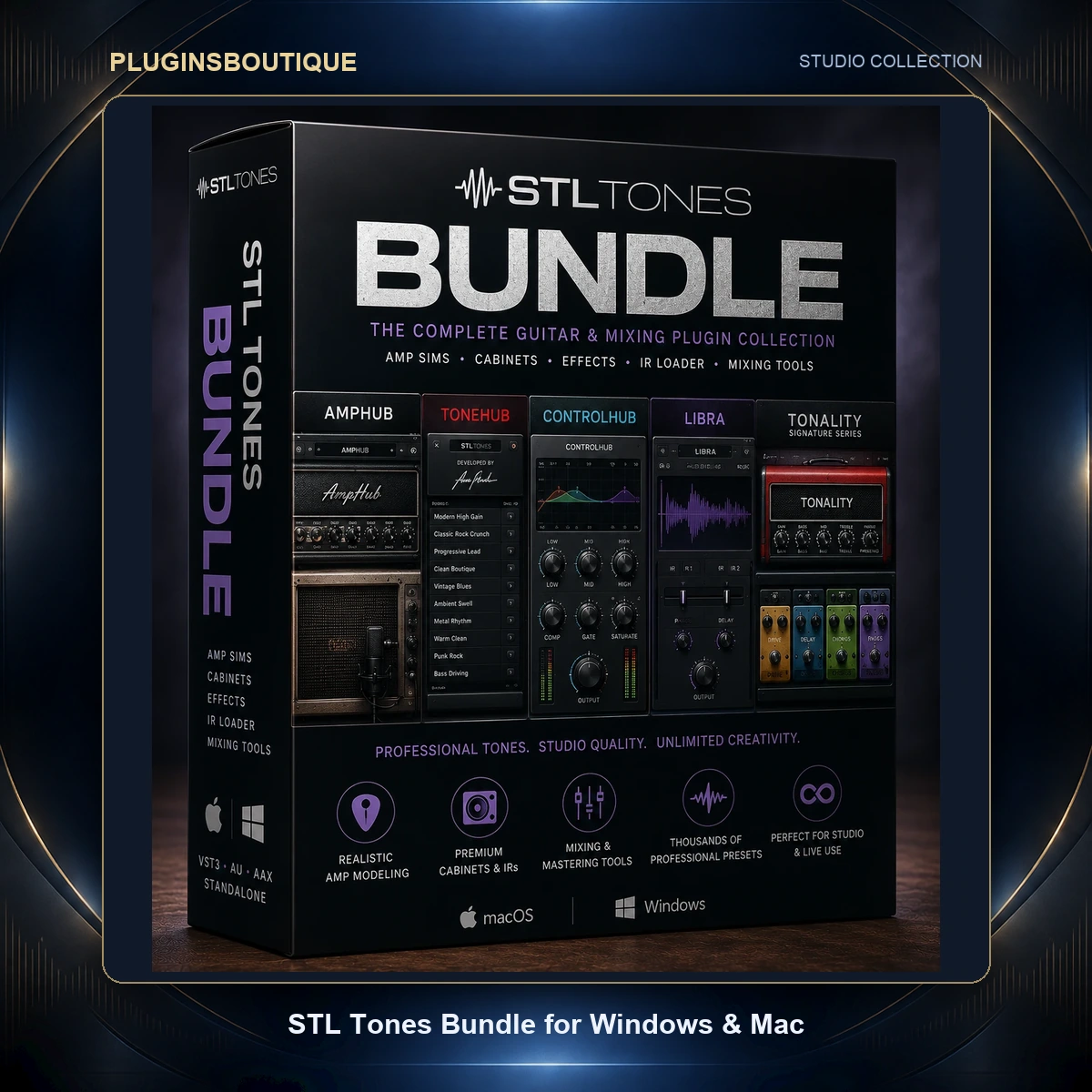
The company deliberately avoids one monolithic plugin. AmpHub models a rig component by component. ToneHub skips modelling and serves captures of finished rigs. ControlHub applies the same recall philosophy to mixing chains. Libra does nothing but cabinets and microphones. Tonality is one producer’s guitar catalogue turned into software.
That split exists because guitarists do not share a workflow. A metal player rebuilding a rig nightly wants every parameter exposed. A songwriter tracking a scratch part at midnight wants a finished sound in two clicks. STL sells both, and the bundle is where the two approaches stop competing.
Inside the Bundle
- AmpHub — an all-encompassing electric guitar suite with an ever-expanding set of stomp-box, amplifier, cabinet, microphone and effect models, aimed at covering any genre.
- ToneHub — capture-based tone, where complete producer-voiced rigs replace component dialling.
- ControlHub — an all-in-one mixing plugin that loads, customises and saves complete signal chains in seconds, including chains built by established mixers.
- Hardware capture — ControlHub can capture your own outboard, making a signature hardware sound recallable in any session.
- Libra — a multi-cabinet microphone simulator for guitar and bass preamps, blending up to eight impulse responses at once.
- Tonality: Howard Benson — a guitar suite developed exclusively from the signature sounds of the multi-platinum producer.
- Expansion packs — including the Chris Lord-Alge Trilogy Preset Pack, built with the five-time Grammy-winning mix engineer.
- Standalone operation — every suite includes a standalone build that runs without a DAW.
The Amp and Cabinet Engine
The division of labour between AmpHub and Libra is worth understanding before you buy, because it is the part most people misread.
AmpHub handles the full chain including its own cabinet section. Libra replaces that final stage with something far more granular — eight impulse responses mixed simultaneously, which is closer to how a real engineer mics a cabinet than a single-IR selector allows. In practice that means two microphones on the grille, a room pair, and a direct blend, all balanced against each other.
Because Libra sits after any preamp, it is not locked to STL’s own modelling. It will happily follow a third-party amp plugin, which makes it useful even to players who prefer another developer’s amp voicing.
ToneHub sidesteps this entirely. A capture already contains the amp, the cabinet, the microphone and the room as one inseparable snapshot. You lose granular control and gain immediacy.
Formats, Hosts and Operating Systems
STL publishes its supported formats plainly, and the coverage is unusually complete for a developer of this size:
- Plugin formats: VST2 (64-bit), VST3 (64-bit), AU (Audio Units) and AAX for Pro Tools.
- Windows: Windows 10 minimum; Windows 11 is the current supported release.
- macOS: requirements vary by product — AmpHub lists macOS 10.13 or later, ToneHub lists macOS 10.15 or later.
- Apple Silicon: officially supported natively, alongside Intel.
- RAM: ToneHub specifies at least 4 GB, with 8 GB or more recommended.
- Licensing: the STL Licensing System, with no iLok account required and three activations per user.
Because VST2, VST3, AU and AAX are all covered, host support is effectively universal: Pro Tools through AAX, Logic Pro and GarageBand through AU, and Cubase, Ableton Live, Studio One, Reaper, FL Studio, Bitwig and Reason through VST3. STL states that its plugins are supported by all major DAWs on Mac and PC.
One practical note on the AAX build: Pro Tools users benefit disproportionately here, since a great many boutique amp developers never ship AAX at all.
Setting It Up
- Create or sign in to your STL Tones account on the official site.
- Visit the file downloads page and fetch the installer for each plugin you own, choosing the Windows or macOS build.
- Run each installer separately — the suites are independent products, not one package.
- Open the plugin in your DAW and sign in with the same credentials as your website account.
- Click Activate now. Subscribers select their subscription; outright purchasers enter the emailed activation code.
- Rescan plugin folders if anything fails to appear.
The recurring support issue: AmpHub, ToneHub and ControlHub carry separate entitlements. If a plugin demands a code while you hold an active subscription, you have almost certainly downloaded a product your subscription does not cover.
Three Rigs, Three Workflows
Tracking a rhythm part at speed
Insert ToneHub on the DI channel, audition captures until one sits, and record. No microphone placement, no cabinet selection, no second-guessing. The standalone build covers the same job when you are practising rather than recording.
Building a lead tone deliberately
Start in AmpHub with the amplifier only and the cabinet section bypassed. Get the gain structure and EQ behaving. Then hand the cabinet stage to Libra, and blend a close microphone against a room capture until the part sits at the right depth. This is the slow route, and it is the one that produces something nobody else’s preset sounds like.
Recalling a mix chain months later
Build your bus chain once in ControlHub, save it, and load it into the next project. If part of your sound comes from real outboard, capture that hardware into ControlHub first so the chain travels intact.
Where It Beats a Physical Rig
Recall is the honest answer. A miked cabinet is not reproducible — move the stand two centimetres and the tone changes. Six months later, when a client asks for a revision, a software chain reopens identically and a real rig does not.
Noise is the second answer. Tracking a high-gain part at three in the morning in a flat is simply not possible with a real amplifier at usable volume.
The third is breadth. Libra’s eight simultaneous impulse responses represent a microphone setup most home studios could never physically assemble, let alone afford.
How It Compares to Other Amp Suites
Against capture-focused platforms, ToneHub occupies similar ground — finished rigs rather than adjustable models — while AmpHub competes with conventional component-level modellers. Buying both approaches from one developer is the bundle’s actual argument.
Two concrete differentiators are worth stating without overclaiming. First, format coverage: VST2, VST3, AU and AAX together is broader than several competing amp suites offer, and the AAX build matters if you are in Pro Tools. Second, licensing: no iLok account is required, which removes both a hardware dongle purchase and an additional account dependency that some competing products impose.
Libra’s eight-IR blending is more granular than the single or dual IR slots common elsewhere, though direct comparison depends heavily on which competing product you have in mind, and impulse response quality matters more than slot count.
Players Who Get the Most From It
- Home recordists with a DI box and no live room.
- Producers who need convincing guitar on deadline without booking a tracking session.
- Pro Tools users, given native AAX support.
- Mixers who rebuild the same chain repeatedly and want it stored once.
- Players who own outboard and want it recallable through ControlHub’s capture.
- Anyone avoiding iLok dongles on principle or through past experience.
Questions Guitarists Ask
Which plugin formats are supported?
64-bit VST2, VST3, AU and AAX.
Does it run natively on Apple Silicon?
Yes. STL lists native Apple Silicon compatibility alongside Intel support.
What is the minimum Windows version?
Windows 10, with Windows 11 as the current supported release.
What macOS version do I need?
It varies by product — AmpHub lists macOS 10.13 or later, ToneHub lists macOS 10.15 or later. Check the specific product page.
Do I need an iLok account?
No. STL uses its own licensing system, and no iLok account is required.
How many machines can I activate?
Three activations per user.
Can I use it without a DAW?
Yes. A standalone version is included, intended for practice and live use.
Will it work in Pro Tools?
Yes, through the AAX build.
How much RAM should I have?
ToneHub specifies 4 GB minimum with 8 GB or more recommended.
What is the difference between AmpHub and ToneHub?
AmpHub models a rig from individual components. ToneHub serves complete captured rigs voiced by producers.
Does Libra work with non-STL amp plugins?
Libra is designed to follow a guitar or bass preamp, so it can sit after third-party amp plugins as the cabinet stage.
How many impulse responses can Libra blend?
Up to eight at one time.
Final Assessment
What makes this collection coherent is that STL never tried to make one plugin serve two incompatible temperaments. The modelling crowd and the capture crowd have genuinely different needs, and pretending otherwise produces software that half-satisfies both.
The specification sheet supports the case: four plugin formats including AAX, native Apple Silicon, Windows 10 upward, and licensing that does not route through iLok. Those are unglamorous details that decide whether software actually gets used.
If you already own a modeller you are happy with, Libra alone may be the interesting component here, since it will follow whatever preamp you prefer. If you are starting from a DI signal and nothing else, the bundle covers the entire distance.
Explore more guitar and amp tools in Mix & Master Plugins, or see the full Plugin Bundles range. Official developer information: stltones.com.



Reviews
Clear filtersThere are no reviews yet.