Try our service free
→ Discover complimentary downloads without needing a payment method.
Browse free




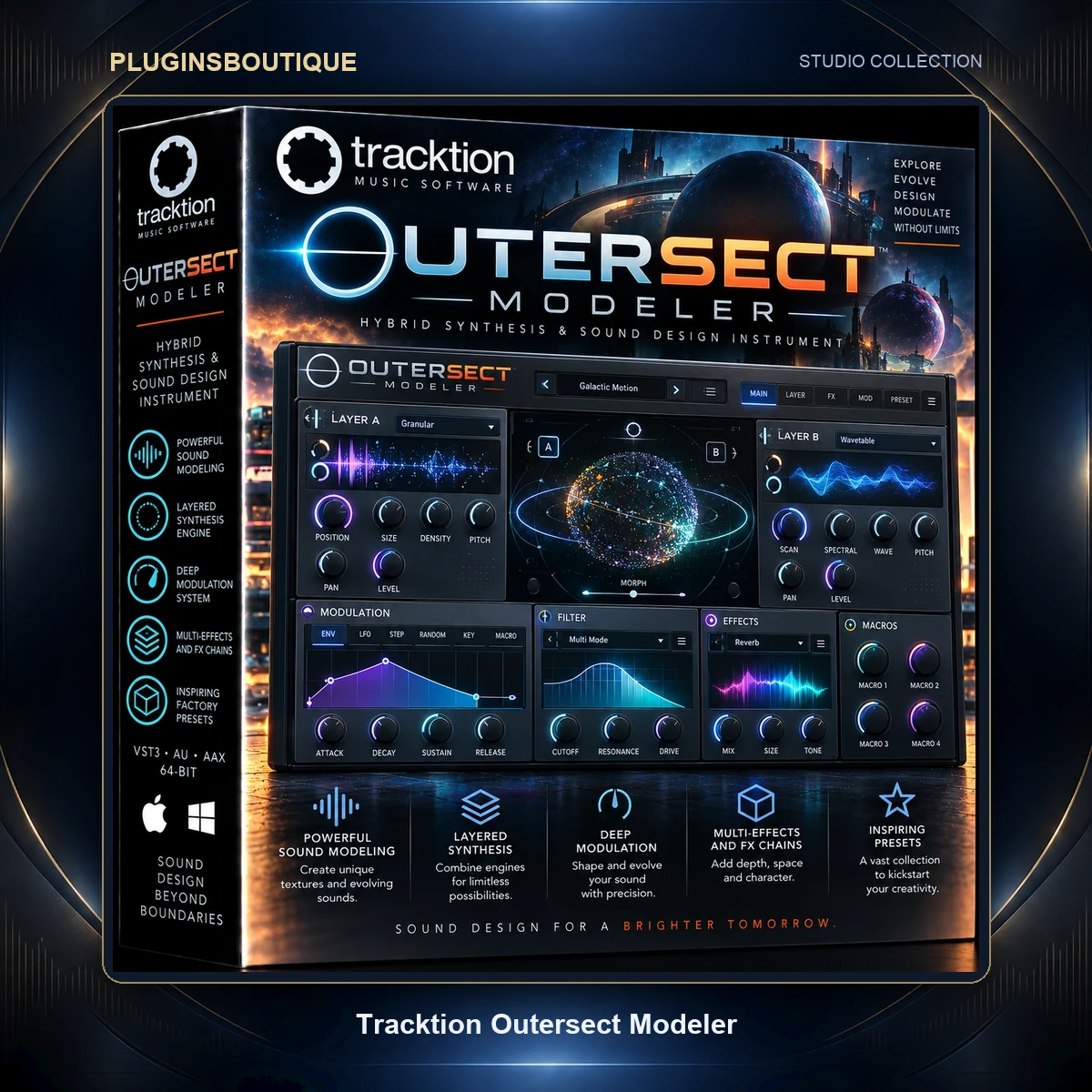


Physical Modeling Reimagined
Many virtual instruments attempt to recreate acoustic instruments using recordings.
Tracktion Outersect Modeler approaches the problem differently.
Instead of playing back a collection of recorded notes, Modeler uses physical-modeling algorithms designed to simulate the behavior responsible for producing the sound.
This distinction becomes particularly important when playing expressively.
A sampled instrument may contain many articulations, but those articulations still need to be recorded and switched between.
A physical model can respond dynamically to performance information.
That is the philosophy behind Outersect Modeler.
Designed to Feel Alive
Tracktion describes Modeler as an instrument designed to behave like a physical instrument.
The engine can produce realistic changes in harmonics and timbre according to how the sound is played.
It can jump harmonics like a flute.
It can produce controlled harmonic feedback inspired by an electric guitar.
It can growl like a saxophone.
It can sing with bowed-string-like expression.
This means the same note does not necessarily need to sound identical every time it is played.
The interaction between the model and the performance can produce organic variations and unexpected sonic results.
Four Physical Modeling Families
Outersect Modeler provides several physical-modeling approaches simultaneously.
These include:
- Plucked string
- Bowed string
- Reed
- Brass
Instead of treating these strictly as separate preset categories, their simultaneous availability makes it possible to explore hybrid instruments.
That is where Modeler can become particularly interesting for sound design.
Plucked-String Modeling
The plucked-string model provides a foundation for sounds inspired by instruments where a string is excited by plucking.
This architecture can be used for realistic instrument-inspired patches, but it can also become a starting point for sounds that do not correspond to any physical instrument.
Physical modeling means characteristics of the virtual instrument can be manipulated instead of simply switching between recorded samples.
Bowed-String Modeling
Bowed strings behave very differently from plucked strings.
Rather than producing a single initial excitation followed primarily by decay, a bow can continuously inject energy into the string.
This makes bowed-string modeling especially interesting for sustained and expressive sounds.
Modeler can use this behavior for violin-like expression as well as more unusual evolving textures.
Reed Modeling
Reed instruments have their own nonlinear performance characteristics.
Modeler’s reed-oriented synthesis contributes to sounds inspired by instruments such as saxophones and other wind instruments.
Tracktion specifically highlights the ability of its sax-style patches to growl, illustrating how the physical model can react more dynamically than a basic static sample.
Brass Modeling
Brass modeling adds another acoustic behavior to the engine.
Combining brass-style resonance with the other available physical models opens the door to hybrid instruments that would be extremely difficult to construct in the physical world.
Electric Guitar-Style Feedback
One of Modeler’s particularly unusual capabilities is electric-guitar-style feedback.
Feedback is an interactive phenomenon.
The instrument, amplification system and resonating string influence one another.
Modeler provides a modeled approach to this behavior, allowing controlled harmonic feedback to become part of a playable synthesizer patch.
Natural & Artificial Harmonics
Modeler supports both natural and artificial harmonics.
Harmonics are important to the identity and expressive behavior of real string instruments.
Providing these behaviors inside the synthesis model contributes to a more organic performance while also opening up additional experimental possibilities.
Flute-Style Overblowing
Tracktion specifically highlights the ability of Modeler’s flute sounds to support overblowing.
In real wind instruments, increasing air pressure can cause the instrument to jump into higher harmonic modes.
Modeler is designed to reproduce this type of behavior.
The result is a sound that can react like an instrument rather than simply triggering a different recorded sample.
Flutter Tongue
Flute-style patches can also reproduce flutter-tongue performance behavior.
These kinds of articulations demonstrate the advantage of building expression into the model itself.
Rather than thinking exclusively in terms of keyswitches and sample layers, the player can interact with the instrument dynamically.
Saxophone Growl
Tracktion also highlights growling behavior in Modeler’s saxophone-style sounds.
Growl can introduce a rougher, more aggressive quality into a wind-instrument tone.
This gives performers another expressive dimension and makes the instrument useful beyond polished orchestral-style emulation.
String Performance Techniques
The included string-oriented patches use performance features designed to let musicians with conventional MIDI controllers reproduce idiomatic string techniques.
Tracktion specifically mentions techniques such as:
- Hammer-ons
- Pull-offs
This helps Modeler remain expressive even when the performer is not using a specialized MPE controller.
MPE Support
For musicians who do use expressive controllers, current versions of Outersect Modeler support MPE.
Beginning with version 1.21 and later, the Settings panel allows the player to select:
- MPE Mode
- Classic MIDI Mode
MPE can provide independent expressive control over individual notes when used with a compatible controller.
This is particularly valuable for a physical-modeling instrument because the synthesis engine can respond dynamically to expressive input.
Classic MIDI Mode
A specialized expressive controller is not required.
Modeler also provides Classic MIDI Mode for conventional MIDI keyboards and controllers.
This allows musicians to take advantage of the physical-modeling engine using standard studio equipment.
Body Filter
Modeler’s Body Filter provides detailed tonal shaping.
The system includes:
- Low-pass filter
- High-pass filter
- Six parametric bands
All six parametric bands are fully modulatable.
The Body Filter can therefore do much more than simply correct EQ.
It can become an active part of the synthesis architecture.
Six Modulatable Parametric Bands
Six parametric bands provide substantial control over resonant structure.
Because they can be modulated, frequency characteristics can change dynamically during a performance.
This is useful when designing both realistic resonating bodies and completely imaginary instruments.
Flexible Modulation Routing
Despite the complexity of the synthesis engine, Tracktion deliberately keeps modulation routing straightforward.
The interface is designed so a knob can be modulated from a source with approximately two mouse clicks.
This reduces the amount of menu navigation required when creating expressive patches.
Single-Page Interface
Deep physical-modeling synthesis could easily result in a complicated interface.
Modeler takes a different approach.
The core synthesis interface fits on one page.
Controls are described using concepts associated with physical instruments and performance techniques rather than forcing musicians to think primarily in abstract mathematical terminology.
Stereo Imaging Pickups
Modeler provides stereo imaging pickups.
This allows the virtual instrument’s sound to be positioned and shaped in stereo at the synthesis level.
Stereo pickup behavior can contribute to width and spatial realism before conventional effects are applied.
Stereo Delay
A built-in stereo delay provides rhythmic and spatial processing.
It can be used subtly to create additional depth or more obviously as part of an experimental sound-design patch.
Stereo Chorus
Stereo chorus adds width and movement.
This can be particularly effective on bowed sounds, atmospheric patches and hybrid physical models.
Stereo Reverb
Integrated stereo reverb places the modeled instrument within a larger acoustic or atmospheric space.
This helps production-ready presets feel complete without immediately requiring an external reverb plugin.
Experimental Soundscapes
Outersect Modeler is not restricted to acoustic-instrument emulation.
Its factory content also includes soundscapes created to explore more avant-garde applications of the modeling engine.
Tracktion credits sound designer Yuli Yolo with ethereal and otherworldly sounds that intentionally move away from recognizable instrument mimicry.
This is an important aspect of Modeler.
Physical modeling can recreate familiar acoustic behavior, but it can also describe imaginary instruments that could never exist physically.
Designed for Production and Live Performance
Tracktion states that the Outersect sound sets supplied with Modeler were refined over many years for both production and live performance.
Lead patches are designed to function as featured sounds capable of occupying the same musical role as:
- A lead vocal
- Electric guitar solo
- Violin solo
- Featured synthesizer
This makes Modeler particularly interesting for keyboardists looking for a highly expressive lead instrument.
Full Automation
Modeler supports full automation.
Parameters can therefore be controlled from a DAW arrangement and incorporated into complex production workflows.
Combine DAW automation with Modeler’s internal modulation and expressive MIDI control for even more detailed movement.
MIDI Learn
MIDI Learn simplifies hardware-controller assignment.
Important parameters can be mapped to physical knobs, faders and other controls for hands-on performance.
This is especially useful for live musicians who want Modeler to behave more like a playable instrument than a mouse-driven software synthesizer.
The Story Behind Outersect Modeler
Outersect Modeler was created by Rob Rayle, also known as Outersect.
Rayle combines experience as a professional music producer with software engineering.
According to Tracktion, his development background includes code for Pro Tools and the S6 console as well as work associated with numerous Roland products.
He has been experimenting with physical modeling since 2004.
From Kyma to Modern Plugin
The Modeler concept originally existed as an add-on for the Kyma Capybara system from Symbolic Sound.
That specialized hardware platform is now discontinued.
Tracktion’s release brings Rob Rayle’s modeling concepts into standard standalone and plugin formats that no longer require specialized hardware.
Outersect Modeler for Strings
Modeler is particularly compelling for string-inspired patches because physical modeling can continuously react to the player’s performance.
Use it for:
- Plucked strings
- Bowed strings
- Hammer-on style articulation
- Pull-off style articulation
- Harmonics
- Hybrid string instruments
Outersect Modeler for Wind Instruments
Wind-inspired patches benefit from the engine’s ability to model behaviors such as:
- Overblowing
- Flutter tongue
- Harmonic transitions
- Growling
- Dynamic timbral changes
These behaviors can make a performance feel considerably more organic.
Outersect Modeler for Guitar-Inspired Sounds
Electric-guitar-style feedback and string modeling make Modeler useful for guitar-inspired synthesis.
It is not simply a guitar sample library.
Instead, the synthesis engine can recreate aspects of string behavior and feedback while allowing the underlying virtual instrument to be changed.
Outersect Modeler for Sound Design
The same physical models can be pushed far beyond realism.
Combine string, reed and brass behaviors with:
- Modulation
- Body filtering
- Feedback
- Stereo pickups
- Chorus
- Delay
- Reverb
The result can become an entirely new imaginary instrument.
Ideal Uses
Tracktion Outersect Modeler is particularly suited to:
- Expressive solo instruments
- Cinematic scoring
- Electronic music
- Ambient music
- Experimental music
- Hybrid acoustic/electronic sounds
- Film and game sound design
- MPE performance
- Live keyboard performance
- Organic synth leads
- Soundscapes
- Imaginary instruments
System Requirements
macOS
Current Tracktion specifications list:
- macOS 10.13 or later
- 64-bit
- Intel Mac
- Apple Silicon
- AAX
- Audio Unit
- VST3
- Standalone
Windows
Current Tracktion specifications list:
- Windows 10
- Windows 11
- 64-bit
- AAX
- VST3
- Standalone
Technical Specifications
| Specification | Details |
|---|---|
| Product | Tracktion Outersect Modeler |
| Developer | Outersect / Rob Rayle |
| Publisher | Tracktion |
| Type | Physical Modeling Synthesizer |
| Plucked String Model | Yes |
| Bowed String Model | Yes |
| Reed Model | Yes |
| Brass Model | Yes |
| Simultaneous Models | Yes |
| Guitar-Style Feedback | Yes |
| Natural Harmonics | Yes |
| Artificial Harmonics | Yes |
| Body Filter | Yes |
| Parametric Bands | 6 |
| Parametric Band Modulation | Yes |
| Stereo Imaging Pickups | Yes |
| Stereo Delay | Yes |
| Stereo Chorus | Yes |
| Stereo Reverb | Yes |
| Full Automation | Yes |
| MIDI Learn | Yes |
| MPE | v1.21+ |
| Classic MIDI | Yes |
| macOS | 10.13+ |
| Windows | Windows 10/11 |
| Intel Mac | Yes |
| Apple Silicon | Yes |
| VST3 | Yes |
| AU | macOS |
| AAX | Yes |
| Standalone | Yes |
| Architecture | 64-bit |
Who Is Outersect Modeler For?
Outersect Modeler is especially useful for:
- Keyboard players
- MPE controller users
- Sound designers
- Film composers
- Game composers
- Electronic producers
- Ambient musicians
- Experimental musicians
- Live performers
- Producers looking for expressive acoustic-inspired synthesis
- Musicians who want alternatives to static sample libraries
Frequently Asked Questions
What is Tracktion Outersect Modeler?
Outersect Modeler is a physical-modeling synthesizer created by Rob Rayle and released by Tracktion. It uses proprietary modeling algorithms to create expressive acoustic, electro-acoustic and experimental sounds.
Is Outersect Modeler sample based?
Its core synthesis concept is physical modeling rather than conventional multisample playback. The engine models instrument behaviors to generate sound dynamically.
What physical models are included?
Tracktion lists plucked-string, bowed-string, reed and brass models, which can be available simultaneously.
Does Outersect Modeler support MPE?
Yes. Version 1.21 and later provides selectable MPE and Classic MIDI modes.
Can I use a normal MIDI keyboard?
Yes. Classic MIDI Mode is designed for standard MIDI controllers.
Can it create guitar-like sounds?
Yes. The engine includes string modeling and electric-guitar-style feedback.
Can it create wind-instrument sounds?
Yes. Tracktion specifically highlights flute-style overblowing and flutter tongue as well as saxophone-style growling.
Does Modeler include effects?
Yes. Its specifications include stereo delay, stereo chorus and stereo reverb.
Does it have MIDI Learn?
Yes. Full automation and MIDI Learn are supported.
Does Outersect Modeler support Apple Silicon?
Yes. Tracktion currently lists both 64-bit Intel and Apple Silicon support on macOS.
Is there a standalone version?
Yes. Tracktion provides standalone operation in addition to plugin formats.
Which plugin formats are supported?
On macOS, Tracktion currently lists AAX, AU and VST3. On Windows, AAX and VST3 are listed.
Conclusion
Tracktion Outersect Modeler offers a fundamentally different approach to virtual instruments.
Instead of attempting to capture every possible performance as a recorded sample, its proprietary physical-modeling algorithms recreate behaviors associated with plucked strings, bowed strings, reeds and brass.
That allows the instrument to react dynamically and produce expressive behaviors such as harmonics, overblowing, saxophone-style growl and controlled electric-guitar-style feedback.
Its six-band modulatable Body Filter, stereo pickups, delay, chorus, reverb and flexible modulation routing extend the engine into serious sound-design territory.
Add MPE support, Classic MIDI operation, MIDI Learn and standalone capability, and Modeler becomes equally relevant to expressive keyboard performance, cinematic scoring and experimental synthesis.
For musicians who want a virtual instrument that responds more like something being physically played—and that can also create instruments that do not exist in the real world—Outersect Modeler provides a distinctive synthesis environment.







Reviews
Clear filtersThere are no reviews yet.