2. Introduction
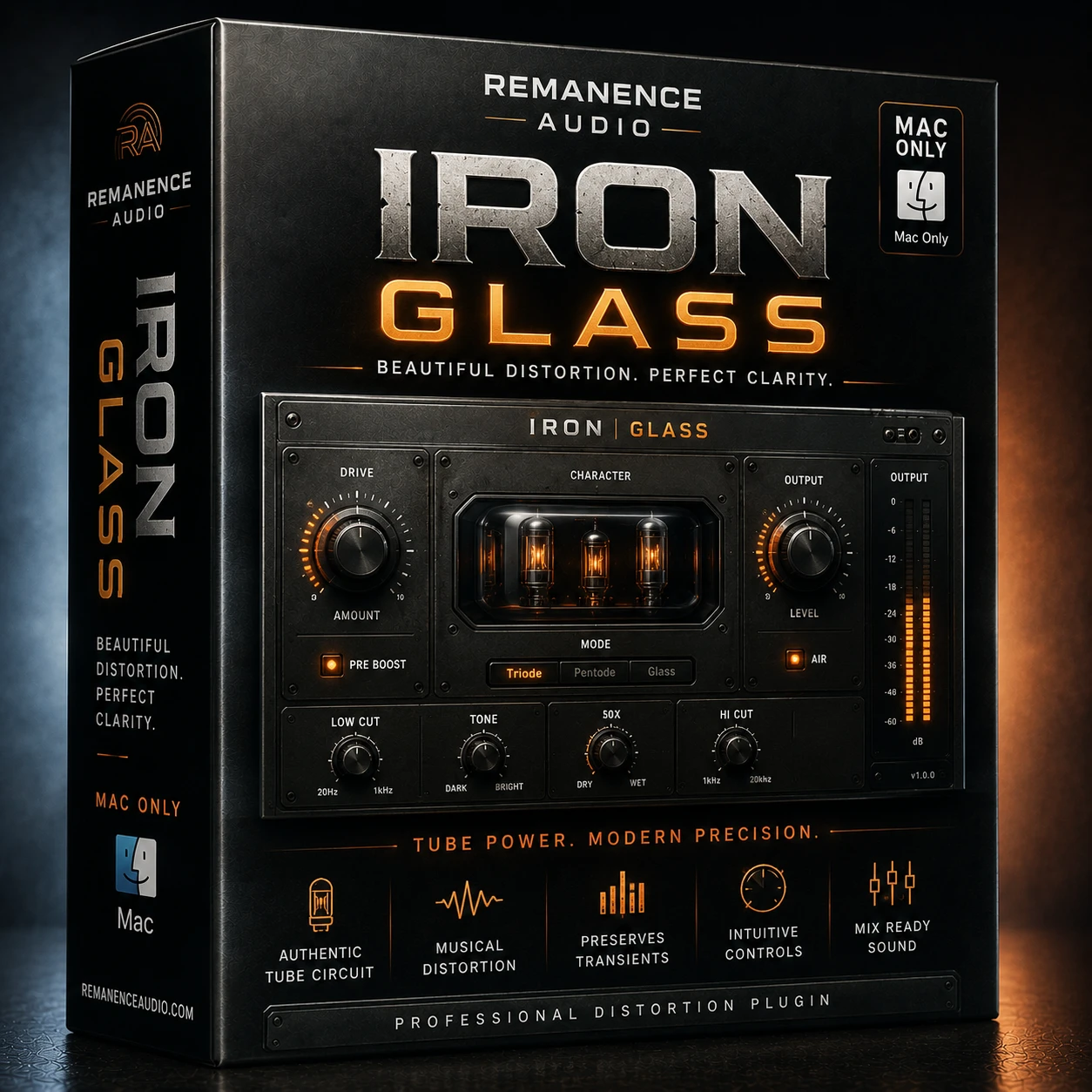
Most EQ plugins in 2026 are variations on the same idea: bands in series, a curve drawn on a screen, and a saturation stage bolted on at the end. The Remanence Audio Iron Glass is not that. It is a five-band parallel EQ in which every band feeds the same circuit-modeled inductor network simultaneously, then passes through modeled tube and transformer stages that behave like real analog parts. Full details are on the official Remanence Audio site.
The difference is audible immediately in the interaction. Because the five bands run in parallel rather than in series, boosting and cutting near the same frequency produces shapes an ordinary serial EQ simply cannot generate. That is the same behavior classic passive hardware equalizers exhibited, and it is why engineers still reach for them. The Remanence Audio Iron Glass models the cause of that behavior rather than approximating the result, with the iron stage genuinely remembering how it just saturated and settling after a transient.
Currently at v1.1.6, the plugin runs as VST3, AU and AAX and is presented here for macOS. It is priced at $75 with a 14-day free trial, having launched at a $50 introductory price. Product specifics are documented on the Iron Glass product page, and you can compare mastering EQ options at Plugin Boutique or Sweetwater.
3. Overview
The Remanence Audio Iron Glass is a mixing and mastering EQ built on parallel passive topology. Five bands operate on the same signal at once and blend back together, exactly as classic passive hardware did, so the bands interact rather than stacking. The signal then passes through a modeled tube-and-transformer output section that adds weight and color which follows the material instead of applying a fixed curve.
Underneath, the implementation is unusually rigorous for an independent release. The inductor network is solved as a real circuit, the high- and low-pass filters are also solved as genuine inductors rather than utility filters bolted on, and the plugin oversamples internally to 192 kHz with ADAA applied to the inductor network for additional antialiasing. Independent L/R or M/S processing is available, along with plus or minus 18 dB of linkable input and output gain so you control exactly how hard the circuit is driven. The full specification is published on the Remanence Audio products page.
Reception has been notably strong. On KVR Audio, one long-standing member wrote that if it were wrapped in a hardware shell, cost 12,000 euros and carried a famous designer’s name, it would be hailed as the best EQ in the world. That quote now sits on the developer’s own homepage — which tells you how confident they are in it.
4. Module-by-Module Breakdown
4.1 Five-Band Parallel Inductor Network
Features
- Five bands processing the same signal simultaneously, then summed
- Circuit-modeled inductor network rather than digital biquad filters
- Bands interact: boosting and cutting near the same frequency creates unique shapes
- Stepped frequency and gain selection plus fine continuous resolution
- Variable Q with five width choices, from narrow bell to broad shelf
Hardware reference: classic passive inductor-based program equalizers, where parallel band topology and real coils produced the interaction curves that serial digital EQs cannot replicate. Documented by Remanence Audio.
Best for: mastering and mix-bus tonal shaping where you want the EQ itself to contribute character, not just correction.
4.2 Glass Stage (Tube Character)
Features
- Tube stage solved as a real circuit, not a static waveshaper
- Adjustable character control that alters the tube’s behavior rather than just its drive level
- Adds midrange density and top-end sheen that tracks the input material
Hardware reference: the valve makeup-gain amplifier that follows the passive filter section in classic tube program EQs, modeled at device level per the Remanence Audio specification.
Best for: vocals and full mixes that need presence and forward sheen without harshness.
4.3 Iron Stage (Transformer Character)
Features
- Transformer stage with genuine magnetic memory behavior
- The iron remembers how it just saturated and settles after a transient
- Adjustable character to change the transformer’s nature, independent of drive amount
- Produces low-end weight and harmonic density rather than simple distortion
Hardware reference: input and output audio transformers in passive EQ signal paths, whose hysteresis and settling behavior define the low-end weight of vintage mastering chains. See the Iron Glass technical notes.
Best for: kick, bass, drum bus and mastering low-end — anywhere you want density that a clean digital EQ cannot produce.
4.4 Inductor-Solved High- and Low-Pass Filters
Features
- HP and LP filters solved as real inductors, not utility filters added on top
- Musical rolloff behavior consistent with the rest of the circuit
- Interacts with the parallel band network rather than sitting outside it
Hardware reference: the passive coil-based filter sections found on hardware program equalizers, implemented as part of the same circuit solve according to Remanence Audio.
Best for: mastering-grade cleanup where a surgical brick-wall filter would sound obviously digital.
4.5 Linkable Gain Staging (plus or minus 18 dB)
Features
- Plus or minus 18 dB of input gain and output gain
- Input and output can be linked so you drive the circuit without changing level
- Direct control over how hard the tube and iron stages are pushed
- Enables honest, loudness-matched A/B comparison
Hardware reference: the input pad and makeup-gain arrangement of hardware mastering EQs, which engineers used to set circuit drive independently of output level. Detailed on the Remanence Audio site.
Best for: deciding how much analog character you want — clean and precise at unity, thick and saturated when driven.
4.6 L/R, M/S Processing and 192 kHz Oversampling with ADAA
Features
- Independent left/right processing for stereo correction
- Mid/side mode for width and center-channel control
- Internal oversampling to 192 kHz
- ADAA (antiderivative antialiasing) applied to the inductor network
Hardware reference: dual-mono and M/S mastering EQ configurations from hardware mastering chains, combined with modern antialiasing DSP as described by Remanence Audio.
Best for: mastering engineers who need to fix stereo imbalance or tighten the center without collapsing width — with no aliasing penalty when driving the circuit hard.
5. What’s Included
| Item |
Details |
| Plugin |
Remanence Audio Iron Glass v1.1.6 |
| Type |
Five-band parallel tube and transformer EQ |
| Bands |
5 parallel bands, stepped plus fine frequency/gain, 5 Q widths |
| Filters |
Inductor-solved high-pass and low-pass |
| Character stages |
Glass (tube) and Iron (transformer), each adjustable |
| Gain |
Plus or minus 18 dB linkable input and output |
| Stereo modes |
Independent L/R and M/S |
| Quality |
192 kHz internal oversampling with ADAA on the inductor network |
| Formats |
VST3, AU, AAX |
| Platform |
macOS (installer package) |
| Documentation |
Iron Glass User Manual (PDF) |
| Trial |
14-day free trial |
| Support |
support@remanenceaudio.com |
| Price |
$75 (launched at $50 intro) |
6. Features Summary
- Parallel five-band topology — all bands act on the same signal and blend, like passive hardware.
- Real circuit-modeled inductor network rather than digital filter approximations.
- Glass tube stage with adjustable character, not just adjustable drive.
- Iron transformer stage with genuine magnetic memory and post-transient settling.
- Inductor-solved HP and LP filters integrated into the same circuit.
- Plus or minus 18 dB linkable gain for precise control of circuit drive.
- Independent L/R or M/S processing for stereo and mastering work.
- 192 kHz internal oversampling with ADAA on the inductor network.
- Stepped and fine resolution on frequency and gain, plus five Q widths.
- 14-day free trial and a straightforward $75 one-time price.
7. Main Highlights (5 Points)
- Parallel bands change the maths. Boosting and cutting near the same frequency produces curves a serial EQ physically cannot make — the reason passive hardware still gets used.
- The iron has memory. The transformer stage remembers its recent saturation and settles after transients, which is why the low end reads as weight rather than distortion.
- Character, not just drive. The Glass and Iron controls change what the tubes and transformers are, not merely how hard they are hit.
- Mastering-grade cleanliness under load. 192 kHz internal oversampling with ADAA on the inductor network means you can drive it hard without aliasing artifacts.
- Hardware-tier praise at a plugin price. A KVR reviewer stated it would be hailed as the best EQ in the world at 12,000 euros in a rack — it costs $75 with a 14-day trial.
8. Why Mastering Engineers and Producers Choose Iron Glass
Mastering engineers choose the Remanence Audio Iron Glass because parallel topology solves a problem that clean digital EQs cannot. When bands interact, small moves produce broad, musical shifts in balance rather than narrow surgical notches — exactly the behavior wanted on a finished mix. Combined with stepped frequency and gain settings, it also encourages the deliberate, repeatable decision-making that mastering demands, while the fine resolution is there when a half-decibel matters.
Mix engineers choose it for the character stages. The Glass and Iron controls are not saturation amount knobs; they change the nature of the modeled tubes and transformers, so the same plugin can be a subtle tone-shaping device at unity gain and a genuinely thick analog colorer when driven. Because input and output gain are linkable at plus or minus 18 dB, you can explore that range without your level judgement being corrupted by loudness.
Producers choose it for the honesty of the engineering and the price. Solving the inductors, filters, tube and transformer as real circuits — then oversampling to 192 kHz with ADAA — is expensive DSP work that most $75 plugins do not attempt. Add a 14-day trial with no purchase pressure and support answered directly by the developer, and the risk of trying it is essentially zero.
9. Professional Workflow Examples
Mastering a full mix (subtle, weight-focused)
- Start in linked L/R mode with input and output gain linked at unity.
- Use the low band for a broad 1 to 1.5 dB shelf lift around 60 to 80 Hz.
- Set Iron character to a moderate position for transformer density in the low end.
- Add a gentle high-band shelf of about 1 dB for air, with Glass adding tube sheen.
- Raise linked input gain by 3 to 6 dB to drive the circuit harder while output compensates.
Passive-style low-end trick (parallel interaction)
- Boost the low band near 100 Hz.
- Cut a nearby band slightly above it.
- Because the bands are parallel, the result is a tightened, forward low end rather than a cancellation — the interaction is the point.
M/S mastering correction
- Switch to M/S mode.
- On mid, gently cut around 250 to 400 Hz to open congestion in the center.
- On side, add a small high-shelf lift for width without pushing the vocal.
- Use the inductor-solved high-pass on the side channel to keep low end mono and solid.
Mix bus and vocal bus coloring
- Insert on the vocal bus and drive input gain harder for tube density.
- Boost high mids by 1 to 2 dB for clarity and bite — small boosts here read as expensive; large ones bring out sibilance.
- Use the low-pass filter to soften digital top end rather than adding a de-esser.
- A/B with input and output linked so you judge tone, not level.
10. Best For
The Remanence Audio Iron Glass is best for:
- Mastering engineers who want passive-style parallel EQ behavior with real tube and transformer color.
- Mix engineers on the mix bus looking for broad, musical tonal moves rather than surgical correction.
- Mac-based producers working in Logic Pro, Pro Tools, Ableton Live or any VST3/AU/AAX host.
- Engineers who love hardware workflow — stepped frequency and gain settings encourage decisive, repeatable moves.
- Anyone doing M/S work, thanks to independent mid/side processing and inductor-solved filters.
- Vocal, bass and drum bus coloring where density and weight matter more than transparency.
It is less suited to surgical problem-solving — notching a narrow resonance or doing dynamic EQ work is better handled by a clean digital equalizer — and the deliberate, hardware-style interface will feel slow to anyone who prefers drawing curves on a spectrum display.
Looking for free plugins? Browse our Free VST Downloads — updated regularly with the best free VST plugins available.
11. Supported Formats
| Platform |
Formats |
Notes |
| macOS |
VST3, AU, AAX |
Installer package (.pkg), current release v1.1.6 |
| Not supported |
VST2, CLAP, standalone |
Plugin formats only |
Compatible with Logic Pro, Pro Tools, Ableton Live, Cubase, Nuendo, Studio One, REAPER, Bitwig, Digital Performer, FL Studio and other VST3/AU/AAX hosts on macOS.
12. System Requirements
macOS
- macOS 10.13 High Sierra or later recommended
- Apple Silicon or Intel Mac
- 64-bit VST3, AU or AAX host
- Modest disk space for the installer package
- 8 GB RAM recommended
Performance notes
- The plugin oversamples internally to 192 kHz with ADAA on the inductor network, so CPU load is higher than a standard digital EQ.
- Use a buffer size of 256 samples or more on dense sessions, or freeze/bounce instances when tracking.
Authorization
13. FAQ
1. What is the Remanence Audio Iron Glass?
It is a five-band parallel EQ for mixing and mastering, built on a circuit-modeled inductor network with modeled tube (Glass) and transformer (Iron) character stages.
2. What does parallel EQ actually mean here?
All five bands process the same signal at once and are then blended back together, the way classic passive hardware worked. This makes the bands interact, so boosting and cutting near the same frequency creates shapes a normal serial EQ cannot produce.
3. What do the Glass and Iron controls do?
They change the character of the modeled tubes and transformers themselves — not simply how hard those stages are being driven.
4. Is it just a saturation plugin with EQ on top?
No. The inductors, high-pass and low-pass filters, tube stage and transformer stage are all solved as real circuits, so the color is a consequence of the circuit rather than an effect added at the end.
5. What formats and platform does it support?
VST3, AU and AAX. This coverage focuses on the macOS release, distributed as an installer package.
6. Does it do mid/side processing?
Yes. It offers independent L/R processing as well as an M/S mode, which makes it genuinely useful for mastering correction.
7. How does it avoid aliasing when driven hard?
It oversamples internally to 192 kHz and applies ADAA (antiderivative antialiasing) to the inductor network for additional antialiasing.
8. How much gain range is available?
Plus or minus 18 dB on both input and output, and the two can be linked so you drive the circuit harder without the output getting louder.
9. Is there a trial, and what does it cost?
Yes — a 14-day free trial is available. The price is $75; it launched at a $50 introductory price for the first two weeks.
10. Is it CPU-heavy?
It is more demanding than a conventional digital EQ because of the 192 kHz oversampling and circuit solving. On a modern Mac this is fine on a mix or mastering bus; use larger buffers if you instantiate many copies.
14. Final Review + Rating
The Remanence Audio Iron Glass is one of the most technically ambitious independent EQ releases of 2026, and the ambition pays off where it matters. The parallel band topology is the headline: interaction between bands genuinely produces curves and low-end behavior that serial digital EQs cannot, and it rewards the classic passive-EQ technique of boosting and cutting adjacent frequencies. The Iron stage is the other standout, with its magnetic memory and post-transient settling giving the low end a density that reads as weight rather than distortion.
The limitations are the natural consequence of the design. This is not a surgical tool — narrow resonance notching and dynamic EQ work belong elsewhere in your chain — and the stepped, hardware-style workflow will frustrate anyone accustomed to dragging nodes on a spectrum analyzer. The 192 kHz internal oversampling with ADAA also makes it noticeably heavier on CPU than a standard EQ, so it is better suited to buses and masters than to thirty simultaneous instances. Documentation is a single PDF manual, which is adequate but sparse for a plugin with this much depth.
At $75 with a 14-day trial, the value is genuinely unusual. A KVR Audio reviewer’s assessment that it would be celebrated as a world-class EQ if it shipped in a 12,000 euro hardware chassis is hyperbole with a real point underneath: the DSP work here is at hardware-emulation flagship level from a one-person developer. For broader context on passive EQ topology and mastering technique, see the coverage at Sound On Sound and Gearnews, and compare mastering EQ pricing at Plugin Boutique or Sweetwater.
| Category |
Rating |
| Sound quality |
9.7 / 10 |
| Parallel band topology |
9.9 / 10 |
| Tube (Glass) character |
9.4 / 10 |
| Transformer (Iron) character |
9.8 / 10 |
| Filters and stereo modes |
9.3 / 10 |
| Workflow and UI |
8.8 / 10 |
| CPU efficiency |
8.5 / 10 |
| Value for money |
9.9 / 10 |
| Overall |
9.4 / 10 — Highly Recommended |












 Download instantly from PluginsBoutique
 Instant Digital Delivery





Reviews
Clear filtersThere are no reviews yet.