Try our service free
→ Discover complimentary downloads without needing a payment method.
Browse free





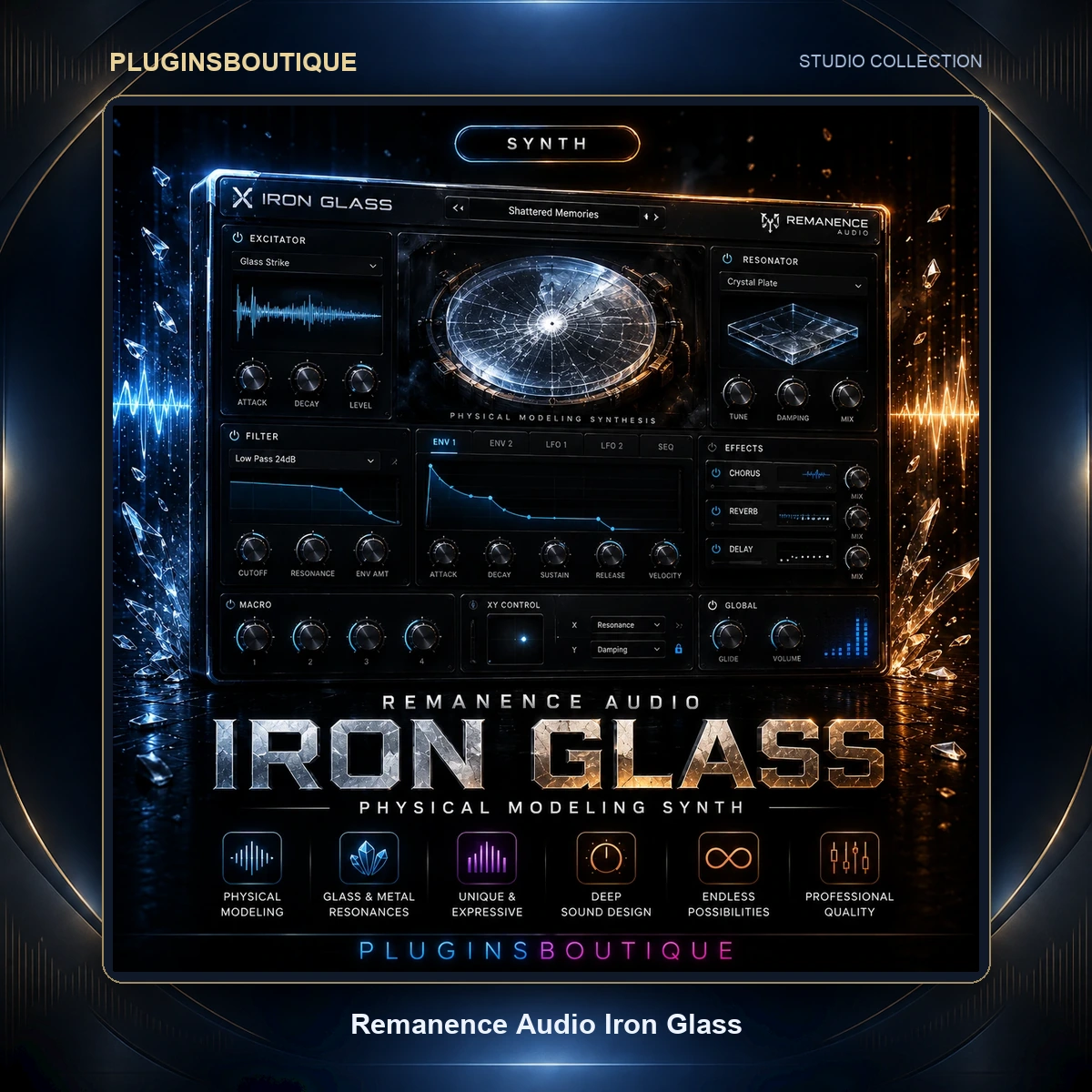


Remanence Audio Iron Glass – Analog Mastering EQ
Remanence Audio Iron Glass is a circuit-modeled equalizer designed for mixing and mastering workflows where frequency shaping and analog-style character need to work together.
Rather than treating an EQ and saturation stage as completely separate processes, Iron Glass is built around modeled analog circuitry including tubes, transformers and an inductor network.
The result is an EQ designed to respond to the incoming signal as a circuit rather than simply applying digital gain changes to individual frequency bands.
A Different Approach to Analog EQ Modeling
Iron Glass began as a free JSFX experiment before being developed into a full plugin.
The developer explains that the original JSFX version approximated analog behavior using interconnected DSP layers, while the full version moved toward detailed circuit modeling.
The current version models the tubes, transformers and inductor network as actual circuit stages rather than simply imitating their sound with a conventional saturation algorithm.
Five Parallel EQ Bands
At the heart of Iron Glass is a five-band parallel EQ architecture.
Instead of processing each EQ band one after another, the five bands work on the same signal and are blended back together.
This approach is designed around the behavior of classic passive-style equalization, where broad tonal changes can interact with the character of the analog circuit.
The five-band structure makes Iron Glass suitable for broad mastering adjustments as well as more focused tonal shaping.
Tube and Transformer Character
Iron Glass includes controls for its tube and transformer behavior.
These controls are not simply conventional drive knobs.
The developer describes them as changing the characteristics of the modeled tube and transformer stages themselves.
That makes the controls useful when you want to alter the overall response and harmonic character of the EQ rather than simply making the signal louder or adding a generic saturation layer.
Transformer Memory
The name Remanence Audio comes from the behavior of magnetic material inside transformers.
When transformer iron becomes saturated, its behavior does not simply return to a completely neutral state immediately afterward.
The developer specifically describes this “memory” after saturation as an important part of the depth and feel of the processor following transients.
This concept is central to the design philosophy behind Iron Glass.
Modeled Inductor Network
Iron Glass also models an inductor network as part of its EQ architecture.
This is particularly important because the filters are not simply standard digital filters placed around a conventional EQ.
The developer describes the high-pass and low-pass sections as being modeled after real inductor-based circuitry.
High-Pass and Low-Pass Filters
The integrated high-pass and low-pass filters provide additional control over the frequency spectrum.
They can be useful during mastering for removing unwanted sub-frequency information, controlling excessive top-end energy or preparing the signal before broader EQ adjustments.
Because these filters are part of the modeled circuit approach, they contribute to the overall character of the processor rather than functioning as completely separate generic digital filters.
Input and Output Gain
Iron Glass provides input and output gain controls with a range of ±18 dB.
This gives users control over how strongly the modeled circuitry is driven while providing a separate output level for managing the final signal level.
This is especially useful when experimenting with the relationship between EQ moves and analog-style circuit response.
Designed for Mixing and Mastering
Iron Glass is particularly suited to mastering-style processing, but it can also be used on individual tracks and buses.
On a mix bus, subtle EQ adjustments can help balance low-end weight, midrange clarity and high-frequency openness.
On individual sources, the circuit character can be used more aggressively to add tonal identity.
Mastering Applications
Mastering is one of the most natural applications for Iron Glass.
The five-band parallel design allows broad frequency shaping without requiring a large chain of separate EQ and saturation plugins.
A mastering engineer might use gentle low-end adjustments, subtle presence changes and high-frequency shaping while allowing the modeled analog stages to contribute additional character.
The key is restraint.
As with hardware mastering EQs, small changes can sometimes produce significant perceived differences.
Mix Bus Processing
Iron Glass can also be placed on a stereo mix bus.
A small amount of EQ combined with controlled circuit drive can help give a mix additional density and tonal cohesion.
Because the input and output stages are part of the overall design, the plugin can be used not only for frequency correction but also for subtle character.
Individual Track Processing
Although designed with mastering in mind, Iron Glass can also be useful on individual tracks.
Possible applications include:
- Vocals
- Drums
- Bass
- Guitars
- Synths
- Piano
- Strings
- Instrument buses
- Drum buses
- Vocal buses
More aggressive settings can be useful when the goal is creative coloration rather than transparent correction.
Why Parallel EQ Matters
The parallel architecture is one of Iron Glass’s most interesting characteristics.
When EQ bands are arranged in a conventional serial structure, the output of one stage feeds the next.
Iron Glass instead processes its five bands in parallel and combines them back into the signal.
This design contributes to the plugin’s approach to broad, musical equalization.
Analog Behavior Instead of a Generic Saturation Effect
A common approach to creating “analog” plugins is to take a digital processor and place a saturation stage before or after it.
Iron Glass takes a different approach.
Its tubes, transformers and inductor network are represented as circuit models, allowing their behavior to form part of the processing itself.
This is one of the main reasons Iron Glass stands apart from a basic EQ with a saturation knob.
Offline Licensing
Iron Glass uses fully offline licensing.
The current product information also states that the plugin includes a fully functional 14-day trial, allowing users to evaluate it before purchasing.
macOS and Windows Support
The current full plugin supports:
macOS
- VST3
- AU
- AAX
- Intel
- Apple Silicon
- macOS 11 and later
Windows
- VST3
- AAX
- 64-bit
- Windows 10 and later
Who Is Iron Glass For?
Remanence Audio Iron Glass is particularly interesting for:
- Mastering engineers
- Mixing engineers
- Music producers
- Recording studios
- Home studios
- Electronic music producers
- Vocal producers
- Engineers looking for analog-style EQ
- Producers who want EQ and circuit coloration in one processor
Final Verdict
Remanence Audio Iron Glass is more than a conventional digital EQ with an analog-style saturation stage.
Its five parallel EQ bands, modeled tubes, transformers and inductor network form the foundation of a processor designed around analog circuit behavior.
The ability to control the modeled tube and transformer characteristics adds another layer beyond ordinary EQ gain controls, while the high-pass, low-pass and ±18 dB input/output gain controls provide a practical mastering workflow.
For engineers looking for a mastering EQ with a strong circuit-modeling philosophy and a distinct analog character, Iron Glass is a particularly interesting addition to a modern plugin collection.
Product FAQ
What is Remanence Audio Iron Glass?
Iron Glass is a circuit-modeled EQ designed primarily for mixing and mastering, with five parallel EQ bands, modeled tubes, transformers and an inductor network.
Is Iron Glass a mastering EQ?
Yes. It is designed with mastering applications in mind, although it can also be used on tracks, buses and mix buses.
How many EQ bands does Iron Glass have?
Iron Glass uses five parallel EQ bands.
Does Iron Glass include tube modeling?
Yes. The plugin models tube circuitry and provides controls for its characteristics.
Does Iron Glass model transformers?
Yes. Both transformer stages are part of the circuit-modeling approach.
Does Iron Glass use an inductor network?
Yes. The EQ architecture includes a modeled inductor network.
Does it have high-pass and low-pass filters?
Yes. Iron Glass includes modeled high-pass and low-pass filter sections.
What is the input and output gain range?
The available input and output gain controls provide ±18 dB of range.
Does Iron Glass support Apple Silicon?
Yes. The macOS version is listed as a universal binary supporting Intel and Apple Silicon processors.
Does Iron Glass support Windows?
Yes. The current version supports 64-bit Windows 10 and later with VST3 and AAX formats.
Does Iron Glass support AAX?
Yes. AAX support is listed for both macOS and Windows.
Does Iron Glass require an internet connection?
The current product information describes fully offline licensing.
Is there a demo?
Yes. A fully functional 14-day trial is available.







Reviews
Clear filtersThere are no reviews yet.