Try our service free
→ Discover complimentary downloads without needing a payment method.
Browse free






A Virtual Piano Designed for Musicians
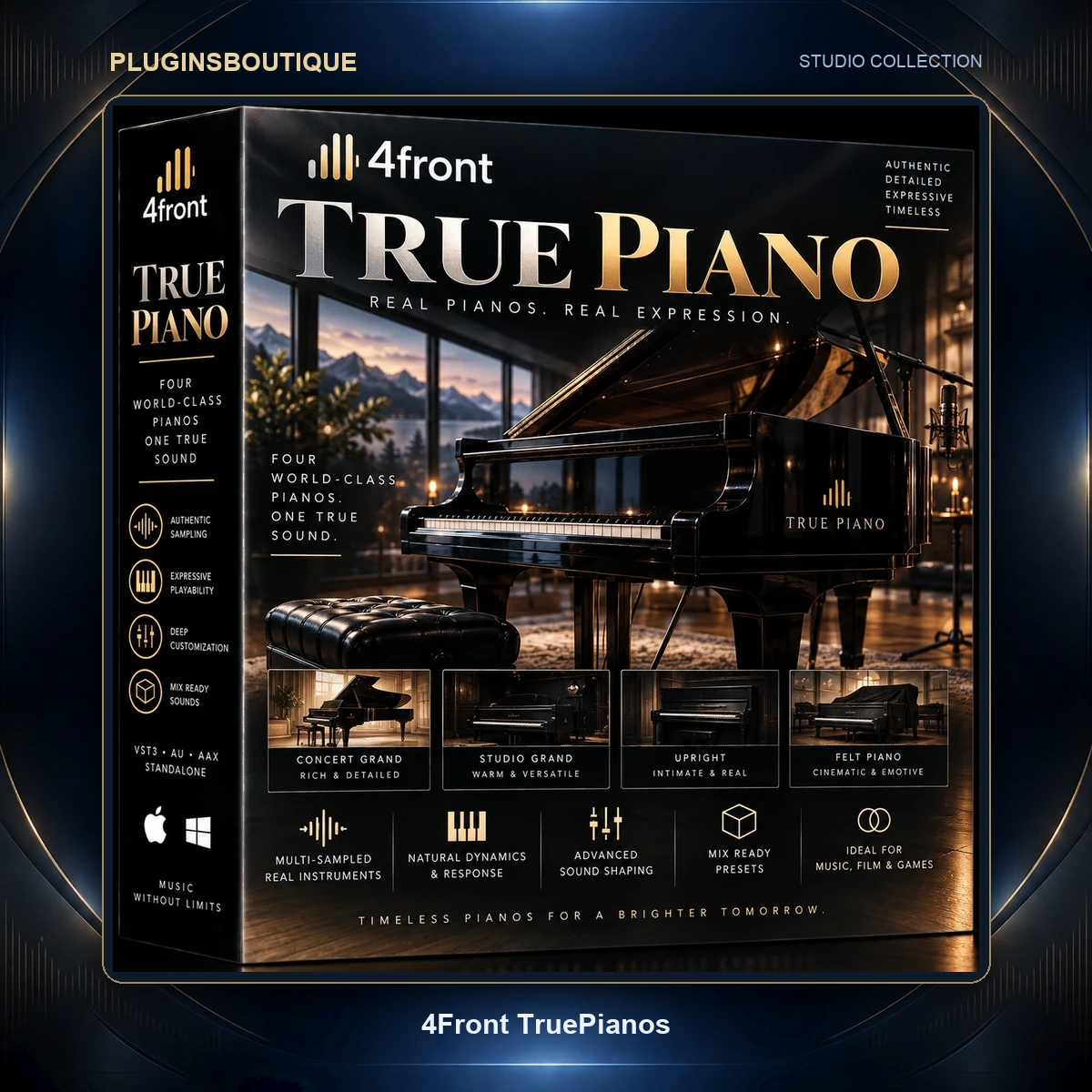
4Front TruePianos is a virtual piano instrument designed around playability, responsiveness and realistic performance.
While many virtual pianos depend on extremely large sample libraries, TruePianos follows a different philosophy. The developer combines different technologies depending on what works best for each aspect of piano reproduction.
Sampling is used where samples provide the desired result, while other techniques are employed where a purely sample-based architecture would make the instrument less flexible.
The result is a virtual piano designed to respond naturally to the musician while maintaining relatively modest system requirements.
Five Piano Modules in One Instrument
The full version of TruePianos contains five piano modules.
Each module represents a different interpretation and tonal variation of a piano. Inside each module, multiple presets provide additional variations in character.
The architecture can therefore be understood as:
Piano Module → Multiple Presets → Individual Piano Character
Instead of identifying every module directly with a particular commercial acoustic piano model, the developer deliberately uses independent module names.
This allows the sound designers to creatively combine source material and processing without suggesting that a module is intended as an exact recreation of one particular physical piano.
Different Piano Characters
TruePianos has historically included recognizable module names such as:
- Amber
- Sapphire
- Diamond
- Emerald
- Atlantis
These modules provide different tonal starting points for different styles and playing techniques.
The variety allows TruePianos to work across solo piano performances as well as productions where the piano needs to fit inside a larger arrangement.
Designed for Real-Time Performance
Performance is one of the central priorities behind TruePianos.
The instrument was specifically optimized for real-time playing, where the response between pressing a MIDI keyboard key and hearing the piano is extremely important.
TruePianos is also designed to make efficient use of modern processors.
For advanced polyphony, processing can be distributed across multiple CPU cores.
This makes the instrument useful for musicians who want expressive piano performance without loading an enormous sample library into memory.
Sympathetic Resonance
One of the important realism features in TruePianos is Sympathetic Resonance.
On a real acoustic piano, strings do not behave completely independently. When certain notes are played or sustained, other strings can resonate sympathetically.
TruePianos includes an option designed to recreate this behavior.
Sympathetic Resonance can be enabled from the instrument’s options screen and contributes additional interaction between notes during expressive piano performances.
Increased Polyphony
TruePianos also provides an Increased Polyphony option.
Polyphony determines how many notes can continue sounding simultaneously.
This becomes particularly important when playing:
- Large chords
- Classical piano
- Sustain-pedal passages
- Fast arpeggios
- Romantic piano
- Cinematic piano
- Dense arrangements
The Increased Polyphony option provides additional headroom for demanding performances, although it also requires additional CPU resources.
Match TruePianos to Your MIDI Keyboard
A virtual piano can only feel natural when it responds correctly to the player’s keyboard.
TruePianos therefore includes dedicated controls for adjusting the relationship between MIDI velocity and the instrument’s dynamic response.
The advanced interface provides control over parameters including:
- Keyboard sensitivity
- Dynamic response
- Release time
- Tuning
- Volume
This means TruePianos can be adjusted to match different MIDI controllers and playing styles.
A player using a lightweight synth-action keyboard may require different sensitivity settings from someone using an 88-key weighted hammer-action controller.
Dynamic Piano Performance
TruePianos is designed to respond dynamically to MIDI performance rather than simply functioning as a static piano playback instrument.
Soft playing can produce a gentler response, while stronger velocity can bring out a brighter and more forceful character.
Fine-tuning the keyboard sensitivity is therefore an important part of configuring the instrument.
Once the response has been adjusted correctly, the settings can be saved as the default state.
Built-In Reverb
TruePianos includes built-in reverb for adding space and ambience to the piano.
This can be useful when playing the instrument standalone or when you want a complete piano sound without loading an additional reverb plugin.
For larger productions, TruePianos can also be combined with external studio effects inside your DAW.
Efficient Hybrid Technology
TruePianos does not describe itself as using only one sound-generation technology.
Instead, 4Front explains that different techniques are combined according to where each approach works best.
Where sampling provides the desired result, samples are used.
Where samples would reduce flexibility, other techniques can be employed.
This hybrid philosophy is one of the reasons TruePianos can provide realistic piano behavior without requiring the extremely large disk footprint associated with some modern multi-gigabyte piano libraries.
TruePianos 2.0
TruePianos is receiving a major modernization with the 2.0 generation.
On macOS, TruePianos 2.0 is officially available and introduces:
- Native Apple Silicon support
- Retina-display support
- VST3
- Audio Unit v3
- AAX
- Rewritten audio engine
- Improved performance
- macOS Tahoe support
For Windows, TruePianos 2.0 is currently available as a public beta and introduces:
- High-resolution display support
- VST3
- Native Windows ARM64 support
- Rewritten audio engine
- Significantly improved performance
The Windows 2.0 beta is backward compatible with TruePianos 1.x, although projects saved using 2.0 are not backward compatible with the 1.x version.
Apple Silicon Support
Modern Mac producers can run TruePianos natively on Apple Silicon.
The current Mac 2.0 release provides native Apple Silicon support instead of requiring the older Intel-only architecture.
This is particularly useful for musicians running current versions of:
- Logic Pro
- GarageBand
- Ableton Live
- Cubase
- Digital Performer
- Pro Tools
- Other compatible Mac hosts
Windows Support
TruePianos also continues to support modern Windows systems.
The developer currently lists:
Windows 7 or later, including Windows 11
The recommended configuration is Windows 10/11 64-bit with a 2.2 GHz or faster compatible processor and at least 512 MB of free RAM.
Lightweight System Requirements
One of TruePianos’ advantages is its relatively modest system footprint.
The developer’s current requirements list only 384 MB of free RAM as the minimum on both Windows and Mac, with 512 MB or more recommended for using the full feature set.
This makes TruePianos particularly interesting for:
- Live-performance laptops
- Older studio computers
- Large DAW projects
- Mobile production setups
- Producers who do not want huge piano libraries
- Systems with limited storage
Standalone Performance
TruePianos can also operate as a standalone instrument.
This means you do not necessarily need to open a full DAW simply to sit down and play piano.
Connect a MIDI keyboard, configure your audio device and use TruePianos as a dedicated software piano.
This can be particularly convenient for practice and live performance.
Great for Different Musical Styles
The different piano modules and presets allow TruePianos to cover a broad range of musical applications.
It can work well for:
- Pop
- Rock
- Jazz
- Classical
- Gospel
- R&B
- Ballads
- Cinematic music
- Songwriting
- Live performance
- Music education
- Piano practice
Technical Specifications
| Specification | Details |
|---|---|
| Product | 4Front TruePianos |
| Type | Virtual Piano Instrument |
| Full Version | 5 piano modules |
| Platforms | Windows / macOS |
| Apple Silicon | Native support in TruePianos 2.0 |
| Windows | Windows 7+, including Windows 11 |
| macOS | macOS 10.13+, including Tahoe |
| Windows Formats | VST2/VST3 depending on version |
| Mac Formats | AU, VST2/VST3, AAX |
| Standalone | Yes |
| Sympathetic Resonance | Yes |
| Increased Polyphony | Yes |
| Multi-Core Processing | Yes |
| Keyboard Sensitivity | Adjustable |
| Dynamic Response | Adjustable |
| Built-In Reverb | Yes |
| Minimum Free RAM | 384 MB |
| Recommended RAM | 512 MB+ |
| Activation | Serial-code based |
Who Is 4Front TruePianos For?
TruePianos is particularly suitable for musicians who prioritize playability and responsiveness.
It is a strong fit for:
- Pianists
- Keyboard players
- Music producers
- Songwriters
- Composers
- Live performers
- Home studios
- Professional studios
- Music teachers
- Students
- Producers working on resource-limited computers
Instead of requiring a huge sample library, TruePianos focuses on creating an expressive instrument that responds naturally to the person playing it.
Frequently Asked Questions
How many pianos are included with TruePianos?
The full version currently contains five piano modules, with multiple presets available within the modules.
Does TruePianos support Apple Silicon?
Yes. TruePianos 2.0 for macOS provides native Apple Silicon support.
Does TruePianos work on Windows 11?
Yes. The developer currently lists Windows 7 and later, including Windows 11.
Does TruePianos support VST3?
Yes. The current TruePianos 2.0 generation supports VST3.
Does TruePianos support AAX?
TruePianos 2.0 for macOS includes AAX support. The current Windows 2.0 public beta describes its AAX implementation as experimental.
Does TruePianos have sympathetic resonance?
Yes. Sympathetic Resonance can be enabled from the options screen.
Can I increase the polyphony?
Yes. TruePianos includes an Increased Polyphony option, although enabling it requires more CPU resources.
Does TruePianos work as a standalone piano?
Yes. Standalone versions are available.
Does TruePianos require internet activation?
Current TruePianos licensing is serial-code based, and the developer states that activation can work without an internet connection.
Is TruePianos fully sample-based?
No. The developer states that TruePianos combines different technologies. Sampling is used where it works best, while other techniques are used where samples would make the instrument less versatile.
Conclusion
4Front TruePianos remains an interesting alternative to enormous sample-based piano libraries because it prioritizes responsiveness, efficiency and expressive performance.
Five piano modules provide different tonal characters, while Sympathetic Resonance, adjustable dynamic response, keyboard sensitivity, increased polyphony and multi-core processing help the instrument adapt to different players and production environments.
With the modern TruePianos 2.0 generation adding native Apple Silicon, VST3, modern display support and a rewritten audio engine, TruePianos is also being updated for current Mac and Windows production workflows.



Reviews
Clear filtersThere are no reviews yet.