Try our service free
→ Discover complimentary downloads without needing a payment method.
Browse free






A Legendary Analog Concept Reimagined
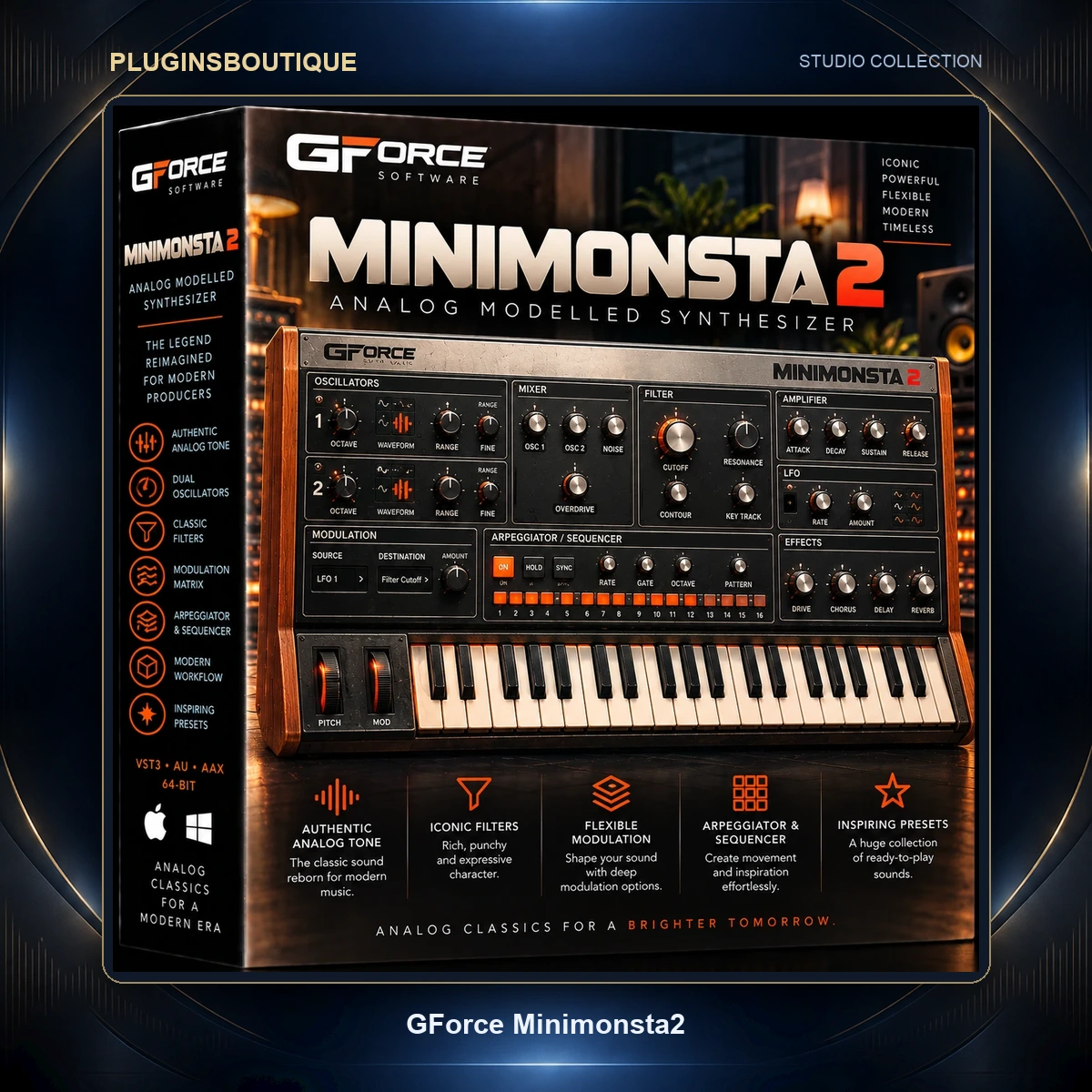
Few synthesizer architectures have influenced electronic music as profoundly as the classic three-oscillator analog monosynth.
Its combination of powerful oscillators, a musical resonant filter and straightforward signal flow helped define countless basses, leads and electronic sounds.
GForce Minimonsta2 takes inspiration from that legendary architecture while refusing to remain limited by the restrictions of vintage hardware.
The result is an instrument that can produce convincing classic analog-style tones while also functioning as a considerably deeper modern synthesizer.
Three-Oscillator Analog-Style Architecture
The foundation of Minimonsta2 is its three-oscillator synthesis architecture.
Multiple oscillators provide the raw material needed to create everything from straightforward single-oscillator tones to enormous stacked sounds.
Oscillators can be combined and detuned to generate:
- Deep basses
- Powerful leads
- Vintage synth tones
- Electronic brass
- Warm pads
- Synth effects
- Experimental textures
The familiar architecture makes Minimonsta2 approachable for musicians who understand subtractive synthesis.
Build Massive Bass Sounds
Minimonsta2 is particularly well suited to bass design.
Three oscillators can be combined to provide weight across different octaves, while the filter shapes the harmonic content into the rounded, aggressive or resonant character required by the production.
Use it for:
- Analog bass
- Funk bass
- House bass
- Techno bass
- Synthwave bass
- Electro bass
- EDM bass
- Cinematic low-end sounds
Expressive Analog Leads
Classic monophonic synthesizers became famous for expressive lead sounds, and Minimonsta2 retains this strength.
Oscillator detuning, filter resonance, envelopes and performance controls can produce everything from smooth melodic leads to screaming resonant solos.
Glide and expressive MIDI control can further transform a simple patch into a highly playable instrument.
Classic-Style Filter Character
The filter is one of the most important parts of this type of synthesizer architecture.
Minimonsta2 provides the resonant analog-style filtering required for warm basses, sweeping leads and animated electronic textures.
Lower the cutoff for smooth and rounded sounds or increase resonance to emphasize frequencies around the cutoff point.
Automating or modulating the filter can turn relatively simple oscillator combinations into highly animated patches.
More Than a Vintage Recreation
A basic recreation of vintage hardware would inevitably reproduce its limitations.
GForce takes a different approach.
Minimonsta2 retains the recognizable workflow and sonic philosophy of a classic analog synthesizer while introducing features that would be impractical or impossible on the original hardware.
This makes it useful for musicians who appreciate vintage synthesizer character but work inside modern DAWs.
The X-Modifier System
One of the defining features of the Minimonsta concept is GForce’s X-Modifier system.
X-Modifiers allow parameters to move dynamically rather than remaining fixed at one value.
This dramatically increases the synthesis possibilities.
Instead of using the instrument only as a traditional static analog synth, parameters can evolve rhythmically and dynamically.
This can create:
- Moving filters
- Rhythmic oscillator changes
- Animated modulation
- Evolving textures
- Pulsating basses
- Sequenced effects
- Complex performance patches
Transform Static Patches Into Moving Sounds
A classic analog patch can be relatively straightforward.
The X-Modifier architecture changes that.
Start with a simple bass or lead and introduce parameter movement to transform it into something significantly more complex.
This makes Minimonsta2 useful not only for recreating traditional analog sounds but also for designing modern electronic patches.
Polyphonic Possibilities
Vintage monosynth architecture naturally suggests single-note basses and leads.
Minimonsta2 is not restricted to this approach.
Polyphonic capabilities open the architecture to:
- Chords
- Pads
- Polyphonic synth parts
- Electronic keys
- Harmonic textures
This is one of the major advantages of recreating classic synthesis architecture in software.
Unison Power
Unison can transform an already powerful analog-style patch into a much larger sound.
Multiple voices can create additional width and density.
This is particularly effective for:
- EDM leads
- Synthwave sounds
- Trance leads
- Modern basses
- Cinematic synths
Use unison subtly for additional richness or push it further for a larger-than-life sound.
Modern Modulation
Minimonsta2 expands modulation beyond what would normally be expected from the original hardware concept.
This additional modulation architecture makes it possible to create patches that move, pulse and evolve over time.
Modulation can also reduce the amount of DAW automation required because movement can be built directly into the patch.
Built-In Effects
Modern software synthesizers benefit enormously from integrated effects.
Effects can transform a raw oscillator-and-filter patch into a polished production-ready sound.
They can contribute:
- Space
- Width
- Movement
- Depth
- Harmonic character
- Rhythmic interest
Keeping processing inside Minimonsta2 also makes presets more portable between projects.
Designed for Performance
Minimonsta2 is not simply a preset playback instrument.
Its architecture encourages interaction.
MIDI controllers can be used to manipulate important parameters in real time, allowing filter movement and other sound changes to become part of the performance.
Velocity and aftertouch capabilities can further increase expression when used with suitable controllers.
Modern Preset Workflow
A deep synthesizer becomes considerably easier to use when sounds can be located quickly.
Minimonsta2 provides a modern preset-oriented workflow so producers can begin with professionally designed sounds and then customize them.
Presets are also valuable learning tools.
Load a patch you like and inspect:
- Oscillator settings
- Filter configuration
- Envelope shapes
- Modulation
- Effects
- X-Modifier behavior
Then modify the patch to create your own version.
Minimonsta2 for House
Classic analog basses remain fundamental to house music.
Minimonsta2 can produce warm low-end sounds, resonant basses, chord textures and melodic synth lines that work naturally in:
- Deep house
- Classic house
- Progressive house
- Tech house
- Funky house
Minimonsta2 for Techno
For techno, Minimonsta2 can move from deep repetitive bass sequences to resonant synth lines and aggressive analog-style effects.
Modulation and X-Modifiers make it especially useful when a repeating part needs to evolve throughout an arrangement.
Minimonsta2 for Synthwave
Vintage analog character is central to synthwave.
Minimonsta2’s architecture works naturally for:
- Retro bass
- Analog leads
- Pads
- Arpeggiated sequences
- Electronic effects
- Vintage-inspired melodic parts
Modern modulation can then push those sounds beyond strict retro recreation.
Minimonsta2 for EDM
The expanded architecture also works well for modern EDM.
Polyphony, unison, modulation and integrated effects can transform classic oscillator shapes into larger contemporary sounds.
Use it for leads, basses, plucks and layered synth parts.
Minimonsta2 for Hip-Hop
Warm analog-style bass remains useful across hip-hop and modern beat production.
Minimonsta2 can provide deep sustained basses, short punchy synth basses and unusual melodic sounds.
Filter and envelope adjustments make it easy to adapt the same basic patch to different arrangements.
Sound Design Beyond Traditional Analog
The greatest strength of Minimonsta2 is that it does not have to remain vintage.
The expanded modulation architecture means the classic signal path can become a starting point rather than an endpoint.
It can create:
- Experimental modulation
- Rhythmic synth textures
- Cinematic effects
- Animated drones
- Evolving patches
- Unusual electronic percussion
- Transition effects
Why Choose Minimonsta2?
There are many virtual analog synthesizers available.
Minimonsta2 stands out by combining two different approaches.
First, it provides a familiar classic analog-style architecture that makes traditional bass and lead programming immediate.
Second, GForce’s expanded modulation and performance system pushes that architecture into modern territory.
You can therefore approach the instrument as either a vintage-inspired synth or a contemporary sound-design environment.
Ideal Uses
Minimonsta2 is particularly strong for:
- Analog bass
- Mono bass
- Leads
- Synth solos
- Pads
- Chords
- Arpeggios
- Sequences
- Plucks
- Electronic FX
- Vintage sounds
- Modern electronic sounds
- Experimental sound design
Plugin Compatibility
Minimonsta2 is designed for contemporary Windows and macOS production environments.
GForce provides modern plugin formats for use with major DAWs.
Because operating-system and DAW support can change with GForce updates, users should confirm the latest compatibility information for their specific system before installation.
Who Is Minimonsta2 For?
GForce Minimonsta2 is particularly suitable for:
- Electronic music producers
- House producers
- Techno producers
- Synthwave producers
- EDM producers
- Hip-hop producers
- Pop producers
- Sound designers
- Film and game composers
- Keyboard players
- Vintage synthesizer enthusiasts
- Producers who want classic analog character with modern flexibility
Frequently Asked Questions
What is GForce Minimonsta2?
Minimonsta2 is an advanced virtual analog synthesizer from GForce Software that expands a classic three-oscillator analog-style architecture with modern modulation, polyphony, effects and performance capabilities.
Is Minimonsta2 only for vintage sounds?
No. Although its core architecture is heavily inspired by classic analog synthesis, its expanded modulation and X-Modifier capabilities make it suitable for contemporary electronic sound design.
How many main oscillators does Minimonsta2 have?
The core synthesis architecture uses three oscillators.
What are X-Modifiers?
X-Modifiers are part of GForce’s expanded modulation system, allowing parameters to change dynamically and creating movement that goes far beyond the limitations of traditional vintage hardware.
Can Minimonsta2 create bass sounds?
Yes. Bass is one of its strongest applications, ranging from warm analog bass to aggressive electronic and modern dance-music sounds.
Can Minimonsta2 create leads?
Yes. Its three-oscillator architecture, resonant filtering, envelopes and performance controls make it particularly effective for expressive lead sounds.
Is Minimonsta2 polyphonic?
Yes. Minimonsta2 expands beyond the monophonic limitations associated with the vintage hardware architecture that inspired it.
Is Minimonsta2 good for techno?
Yes. Its analog-style bass, resonant filtering and advanced modulation make it particularly useful for techno and other electronic genres.
Is Minimonsta2 good for synthwave?
Yes. Its classic analog character is well suited to retro and synthwave production, while its modern features allow those sounds to be expanded considerably.
Does Minimonsta2 work on Mac and Windows?
Yes. GForce develops Minimonsta2 for contemporary macOS and Windows music-production systems. Check GForce’s current compatibility information for exact supported OS and plugin versions before installation.
Conclusion
GForce Minimonsta2 takes one of the most influential approaches to analog synthesis and turns it into a considerably deeper software instrument.
The familiar three-oscillator architecture, powerful analog-style filtering and envelope-based sound shaping provide an excellent foundation for basses, leads and vintage synth sounds.
But the instrument’s real strength appears when its modern capabilities are used.
GForce’s X-Modifier system, expanded modulation, polyphony, performance controls and integrated processing allow classic analog-style patches to evolve into complex contemporary sounds.
Whether you need a deep bass, expressive synth lead, warm chord patch, moving electronic sequence or experimental texture, Minimonsta2 combines the immediacy of vintage subtractive synthesis with the flexibility expected from a modern software instrument.







Reviews
Clear filtersThere are no reviews yet.