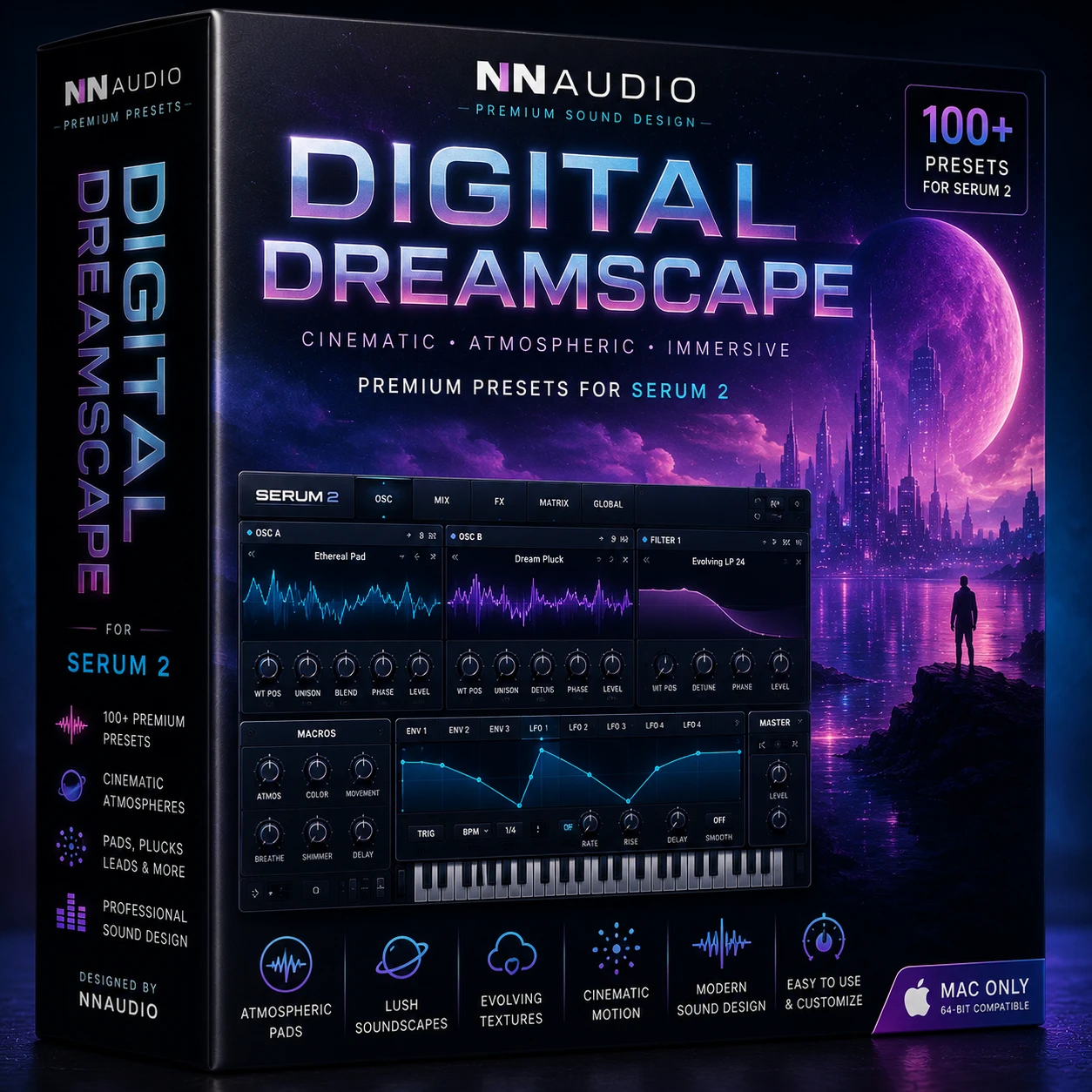
NNAudio Digital Dreamscape
Overview
Layering is where most sampled instruments actually earn their place in a track. A single string patch is rarely the finished sound; the useful result comes from a string layer plus a soft pad plus something percussive to define the attack. Producers know this, which is why so many sessions contain three instances of the same instrument fighting for CPU.
Digital Dreamscape addresses that pattern directly. Four independent engines run inside one instance, each loading any of 315 multi-sampled instruments, so the layering happens where the sounds live rather than across four separate plugin windows and four sets of automation lanes.
Source material comes from live, analog and digital recordings, occupying roughly 3.19 GB. The blend of source types is deliberate: an acoustic recording, an analog synth capture and a digital texture behave differently under the same processing, and combining them is what produces a layer that reads as one instrument instead of three.
Beyond the sample engines, each slot adds dual oscillators with waveform selection — up to six voices in total — and the whole instrument runs into a full effects suite. Over 500 factory presets demonstrate the combinations. New Nation ships it as VST3 and AU.
Why Choose This Rompler
Consolidation is the practical argument. Four engines in one window means one plugin instance, one set of automation lanes and one preset that recalls the entire layered sound. Rebuilding a four-instance stack from memory six months later is the kind of task that quietly wastes an afternoon.
Source variety is the second reason. A library restricted to orchestral samples or to analog synth captures produces layers that all share the same character. Drawing from live, analog and digital recordings means the four slots can contribute genuinely different qualities — body from one, movement from another, edge from a third.
Third, the oscillators alongside the samples cover a specific weakness. Multi-sampled instruments can lack low-end solidity, particularly when the source was recorded acoustically. A synthesised waveform underneath fills that without requiring a separate bass instrument.
Fourth, 200% width emulation in the Stereo Dimension section is more useful than the number suggests. Layered sounds tend to congest in the centre, and being able to spread individual elements outward is often what separates a stack that sounds wide from one that just sounds loud.
Key Features
- Quad engine architecture — blend up to four instruments simultaneously in one instance.
- 315 multi-sampled instruments sourced from live, analog and digital recordings.
- 3.19 GB sample library supplying the instrument content.
- Over 500 factory presets covering the engine combinations.
- Dual oscillators with waveform selection per engine, providing up to six total voices for depth and clarity.
- Full FX suite processing the combined output.
- Stereo Dimension with up to 200% width emulation.
- Designed for modern production rather than as a general-purpose orchestral library.
- VST3 and AU formats.
- Windows and macOS support.
What’s Included
The purchase covers the Digital Dreamscape plugin, the 3.19 GB instrument library of 315 multi-sampled sources, and the factory preset bank of over 500 patches.
New Nation also publishes other instruments under the NNAud.io name, including Mesosphere and the ROMPL Workstation, alongside an account system for managing owned products.
System Requirements
The developer publishes these figures:
- Windows: Windows 10 or later
- macOS: Mojave 10.14 or later
- RAM: 8 GB
- Disk space: 4 GB, accommodating the 3.19 GB sample content
- Formats: VST3 and AU
- Host: any 64-bit DAW supporting those formats
One limitation needs stating plainly: there is no AAX build, so Pro Tools is not supported. Every other major DAW handles VST3 or AU, but Pro Tools users should factor this in before purchasing. The 8 GB RAM figure is also a floor rather than a comfortable target when four sample engines are loaded across several tracks.
Installation Guide
- Download the installer and the sample content for your operating system from NNAud.io.
- Run the installer and select VST3, AU or both depending on your host.
- Choose a location for the 3.19 GB sample library. An SSD improves patch loading noticeably.
- Complete registration or activation as directed by the developer.
- Rescan plugin folders in your DAW and load Digital Dreamscape as an instrument.
- Open a factory preset and inspect which four instruments it uses — the combinations are the quickest way to learn what the library contains.
Reverse-engineering the presets is genuinely the efficient route here. Auditioning 315 instruments individually takes hours; seeing which four a good preset combines teaches you the useful pairings straight away.
Compatibility
VST3 and AU coverage reaches Ableton Live, Logic Pro, FL Studio, Cubase, Studio One, Reaper and Bitwig on both Windows and macOS. Audio Units is macOS-only by design, so Windows users work in VST3.
Pro Tools is the exception, since it requires AAX and no AAX build exists. Pro Tools users needing these sounds would have to record them from another host, which is a workaround rather than a solution.
Who Is This Instrument For?
- Producers building atmospheric and cinematic beds, where layered textures matter more than individually accurate instruments.
- Beatmakers wanting quick melodic content without assembling a stack of separate plugins.
- Composers working to deadline, since 500 presets built from four-way blends cover a lot of ground quickly.
- Anyone whose sessions routinely contain three layered instruments doing what one plugin could handle.
- Producers with modest sample libraries looking for breadth from a single purchase.
This is not a substitute for a detailed orchestral or acoustic instrument library. Multi-sampled sources built for blending are optimised for how they combine, not for solo exposure with full articulation control.
Workflow Benefits
One instance in place of four changes session management more than it changes sound. Automation lives in a single lane, CPU accounting is simpler, and the preset recalls everything — including how the four sources were balanced against each other. Stacked instances never recall that relationship.
Blending also happens at the right point in the signal path. Four instruments summed inside the instrument hit the effects suite together, so a single reverb or width setting treats them as one sound. Layering across separate plugins means either processing each individually or routing them all to a bus, which is more setup for the same result.
Presets built from four-way combinations shorten the search as well. Finding a usable layered texture normally means auditioning instruments, then auditioning combinations, then balancing them. Starting from a working blend collapses three tasks into an adjustment.
Frequently Asked Questions
1. What is a quad rompler?
A sample playback instrument with four independent engines, allowing four sampled sources to be blended within one instance.
2. How many instruments are included?
315 multi-sampled instruments, of which any four can be combined at once.
3. Where do the samples come from?
Live, analog and digital recordings, giving the four slots genuinely different sonic characteristics.
4. How large is the library?
Around 3.19 GB of sample content, with 4 GB of disk space recommended.
5. How many presets ship with it?
Over 500 factory presets.
6. What do the oscillators add?
Each engine includes dual oscillators with waveform selection, contributing up to six voices in total for extra depth.
7. What is Stereo Dimension?
Part of the effects suite, providing width emulation of up to 200%.
8. Which formats are available?
VST3 and AU. Audio Units is macOS-only, so Windows hosts use VST3.
9. Does it work in Pro Tools?
No. Pro Tools requires AAX and no AAX build is offered.
10. What operating systems are supported?
Windows 10 or later and macOS Mojave 10.14 or later.
11. How much RAM is needed?
8 GB is the published requirement. More is advisable when running several instances.
12. Can I load my own samples?
It plays its supplied library. Check with the developer regarding any user import capability.
13. Who develops it?
New Nation, publishing under the NNAud.io name.
14. Is it suitable for orchestral scoring?
It suits atmospheric and hybrid work. Detailed orchestral writing needs a library built for articulation control.
Conclusion
Most romplers compete on how many instruments they contain, which is why 315 sounds like the headline figure here. It is not. The number that matters is four — how many of those instruments can sound at once, inside one instance, recalled by one preset.
That single architectural choice turns a large sample library into a layering instrument, and layering is what producers were doing with romplers anyway. The absence of an AAX build is a genuine limitation worth checking against your setup, but for everyone outside Pro Tools the design solves a real and familiar annoyance.
Sampled instruments are collected under VST Instruments, synthesisers under Synth Plugins, and sound content under Samples & Presets. Specifications are published by the developer at nnaud.io.







 Download instantly from PluginsBoutique




Reviews
Clear filtersThere are no reviews yet.