2. Introduction
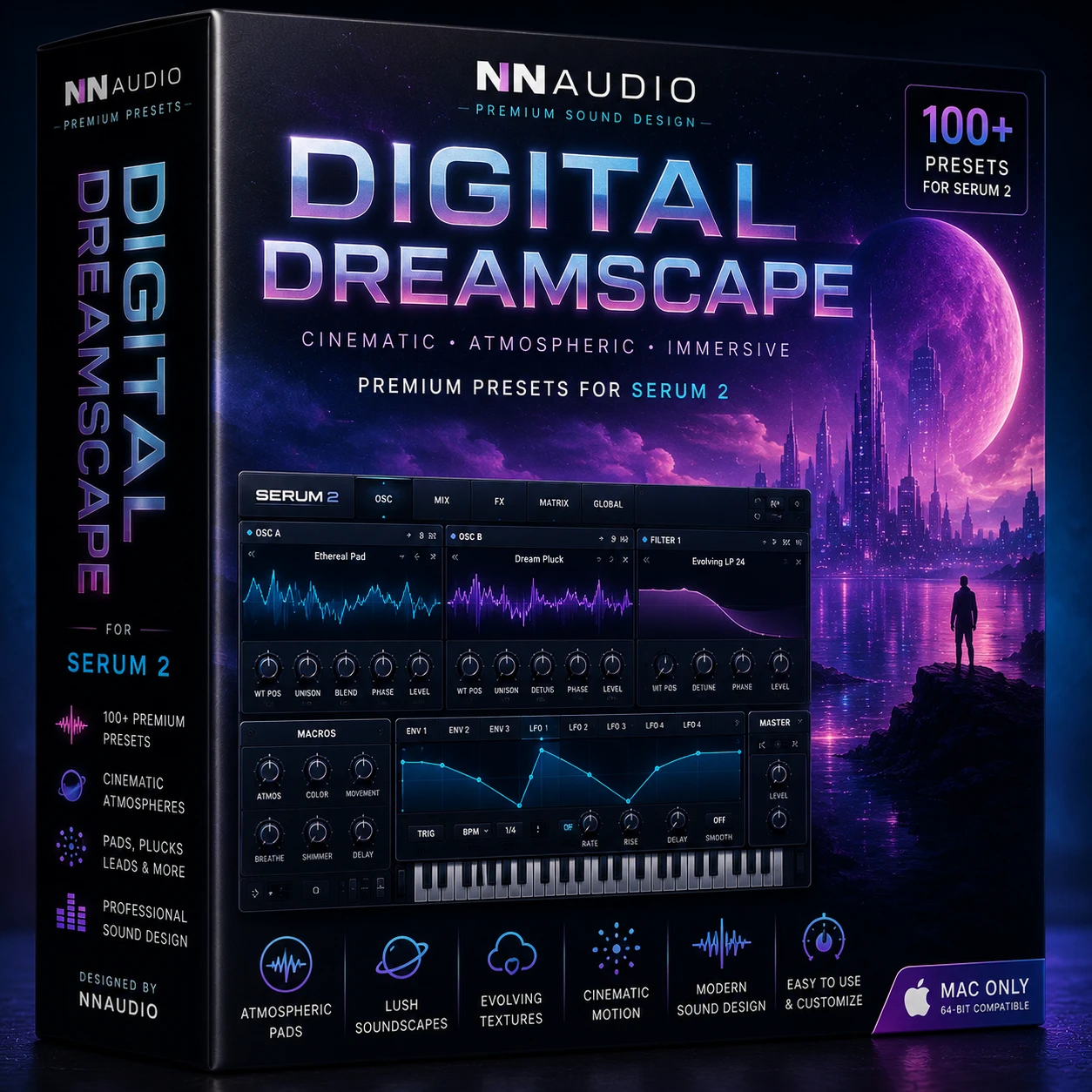
NNAudio Digital Dreamscape is a quad engine rompler built for producers who want finished, evocative, screen-filling sound in a couple of clicks rather than an hour of patch building. Released by NNAudio (also branded New Nation) and available directly from the developer at nnaud.io, it takes 315 high-quality multi-sampled instruments recorded from live, analog and digital sources and lets you stack up to four of them at once inside a single instrument.
That simple premise is what makes NNAudio Digital Dreamscape so effective. Romplers historically traded depth for immediacy, and boutique synths traded immediacy for depth. Digital Dreamscape sits between the two: the sample content does the heavy lifting, the dual oscillator section adds synthetic body, and the built-in FX suite — reverb, delay, filtering and a Stereo Dimension stage with up to 200% width emulation — handles the polish. With over 500 factory presets on board, most sessions start with a sound that already works in the mix.
This review covers every engine, the full specification, formats, system requirements, workflow examples, ten frequently asked questions and a final rating, all verified against the official NNAudio product page.
3. Overview
NNAudio Digital Dreamscape is a sample-playback instrument with a matrix-style interface. Four independent rompler slots each load one of 315 multi-sampled instruments; you balance, tune and process them together, then save the result as a patch. Layered on top are dual oscillators with waveform selection that push the total voice count to six per note, giving you a way to add sub weight, harmonic edge or air to a sampled layer without leaving the plugin.
The instrument ships as VST3 and AU for Windows 10 and later and macOS Mojave 10.14 and later, and it is compatible with every major DAW except Pro Tools, since there is no AAX build. The installer is a modest 256 MB, while the sample archive is roughly 3.19 GB, so plan for around 4 GB of free disk space. NNAudio lists Digital Dreamscape at $99.95 with a standing sale price of $69.95, and deal retailers have run it far lower during promotions — VSTAlarm has advertised it at $19.95 against a $124.95 list price. Comparison shopping is worth the five minutes; it is also worth checking major retailers such as Plugin Boutique and Sweetwater for bundle pricing before you commit.
4. Engine-by-Engine Breakdown
4.1 The Quad Rompler Matrix
The centrepiece of NNAudio Digital Dreamscape is the four-slot matrix. Each slot is a complete rompler voice with its own instrument selection, level, pan and tuning, and the four run in parallel so a single MIDI note can trigger a felt piano, a bowed string swell, a granular texture and a analog pad simultaneously.
- Features: four independent rompler engines, per-slot instrument browsing, per-slot level and pan, parallel playback from one MIDI input, patch saving across all four slots.
- Hardware reference: multi-part romplers of the late eighties and nineties — the Korg M1 and Roland JV-1080 — built their reputation on stacking two to four sampled partials into one instantly usable patch. Digital Dreamscape follows the same architecture with a modern library and no voice-card limits.
- Best for: producers who build sounds by layering rather than by subtractive editing, and anyone who needs a full arrangement bed from one instrument track. Full details are on the official Digital Dreamscape page.
4.2 The 315-Instrument Multi-Sample Library
The library is the reason to buy. All 315 instruments are high-quality multi-samples captured from live performances, analog hardware and digital sources, which means the collection spans acoustic realism, vintage synth character and pure sound design texture in one place.
- Features: 315 HQ multi-sampled instruments, live/analog/digital source material, multi-sampled velocity and range mapping, roughly 3.19 GB of content, browsable per engine slot.
- Hardware reference: the classic sampler libraries built for the E-mu Emulator II and Akai S1000 defined the idea of a curated, character-first instrument set rather than an exhaustive orchestral archive. Digital Dreamscape’s library is curated the same way.
- Best for: scoring, ambient, lo-fi, cinematic and electronic work where distinctive tone matters more than symphonic completeness. Browse the instrument list at nnaud.io.
4.3 Dual Oscillators and the Six-Voice Architecture
Sitting alongside the sample engines are dual oscillators with waveform selection. Combined with the rompler slots, they take you up to six total voices per note, which is what gives NNAudio Digital Dreamscape more depth and clarity than a pure sample player.
- Features: two oscillators with selectable waveforms, up to six total voices per note, oscillator blending against the sampled layers, added low-end weight and high-frequency definition.
- Hardware reference: the Roland D-50 pioneered exactly this hybrid — short sampled attack transients fused with synthesised sustain — and it remains the most elegant solution to making samples feel alive.
- Best for: thickening thin sample layers, tuning sub content under a pad, and adding movement to static textures. See the specification at the developer’s site.
4.4 Stereo Dimension with 200% Width Emulation
The Stereo Dimension module is the single most distinctive part of the FX suite. It widens the stacked layers up to 200% width emulation, turning a centred stack into a wall of sound that still collapses acceptably in mono.
- Features: stereo width emulation up to 200%, applied post-mix across the layered engines, dimension-style chorused spread, mono-compatibility-conscious processing.
- Hardware reference: the Roland Dimension D (SDD-320) built its legend on subtle chorused stereo expansion that never announced itself as an effect. This module chases the same result on sampled material.
- Best for: pads, intros, breakdowns, choirs and anything that needs to feel wider than the speakers. Documented on the NNAudio product page.
4.5 Reverb and Delay Modules
Digital Dreamscape includes reverb and delay inside the instrument so patches arrive pre-glued. Reverb supplies the lush reverberation the plugin’s name promises, and delay adds rhythmic depth that turns a sustained note into a moving figure.
- Features: built-in reverb for space and tail length, delay for rhythmic depth and echo repeats, per-patch effect settings saved with the sound, wet/dry balance against the dry stack.
- Hardware reference: the Lexicon 224 for ambient reverb tails and the Roland RE-201 Space Echo for musical, character-rich repeats are the reference points for this kind of instrument-level ambience.
- Best for: ambient and cinematic work where the reverb is part of the instrument rather than a send. Details at nnaud.io.
4.6 Filtering and Frequency Shaping
The FX suite finishes with filtering to shape frequencies, letting you carve the stacked engines into a mix without reaching for an EQ on the channel strip.
- Features: filter section for frequency shaping, applied to the summed engine output, useful for taming bright multi-samples and for filter-swept transitions.
- Hardware reference: the Oberheim SEM and the classic Moog ladder filter remain the benchmarks for musical, character-adding filtration rather than surgical correction.
- Best for: fitting big layered patches under a vocal, and building sweeps and risers inside the instrument. Confirmed on the official page.
5. What’s Included
| Item |
Detail |
| Instrument |
NNAudio Digital Dreamscape quad engine rompler |
| Rompler engines |
4 independent slots, blendable |
| Instrument library |
315 HQ multi-sampled instruments |
| Factory presets |
Over 500 |
| Oscillators |
Dual oscillators with waveform selection (up to 6 total voices) |
| FX suite |
Reverb, delay, filter, Stereo Dimension up to 200% width |
| Formats |
VST3, AU |
| Platforms |
Windows 10+, macOS Mojave 10.14+ |
| Installer size |
256 MB |
| Sample content |
3.19 GB |
| Delivery |
Windows EXE, macOS DMG, plus sample archive ZIP |
| Licence |
Perpetual licence via NNAudio account |
6. Features Summary
NNAudio Digital Dreamscape combines a four-engine rompler matrix, a 315-instrument multi-sample library sourced from live, analog and digital recordings, dual waveform-selectable oscillators reaching six voices per note, and a complete internal FX suite covering reverb, delay, filtering and 200% Stereo Dimension width. Over 500 factory presets ship with the instrument, delivered as VST3 and AU for Windows and macOS with a 256 MB installer and a 3.19 GB sample archive. The design goal throughout is immediacy: load a preset, blend the four slots, and the sound is mix-ready.
7. Main Highlights
- Four blendable rompler engines let one MIDI track carry an entire atmospheric arrangement.
- 315 high-quality multi-sampled instruments drawn from live, analog and digital sources give genuine tonal variety, not variations on one library.
- Over 500 factory presets mean the instrument is productive in the first minute, before you learn a single control.
- Stereo Dimension up to 200% width produces the wide, dreamlike image the plugin is named for without an external widener.
- Aggressive real-world pricing — a $99.95 list that regularly sells for $69.95 or far less — makes it one of the strongest value instruments in its class.
8. Why Producers and Composers Choose NNAudio Digital Dreamscape
Producers choose NNAudio Digital Dreamscape because it removes friction. Ambient, cinematic and lo-fi work depends on texture, and texture is normally assembled from three or four separate instrument tracks plus sends. Digital Dreamscape collapses that into one plugin instance with four layers and an internal effects chain, so an idea survives the gap between hearing it and recording it.
Composers choose it for the sample sourcing. Because the 315 instruments come from live, analog and digital recordings, patches carry the small irregularities that make sampled material sit convincingly against real players. Beatmakers choose it for the preset count and the price. And engineers appreciate that the Stereo Dimension stage is built around emulation of a genuinely musical widening approach rather than a crude mid/side boost that falls apart in mono.
9. Professional Workflow Examples
Cinematic underscore bed. Load a bowed string multi-sample in slot one, a granular texture in slot two, a soft mallet in slot three and an analog pad in slot four. Filter the top off the texture, push Stereo Dimension to around 150%, add a long reverb tail, and hold a two-note movement under the picture.
Lo-fi hip hop keys. Use one slot only — a sampled electric piano — then add the second oscillator underneath for sub weight. Short delay, modest reverb, filter the highs, and print the take with the FX baked in.
Ambient intro that becomes a drop. Build a four-slot stack at full width and long reverb for the intro, automate the filter closed across eight bars, then automate Stereo Dimension back to 100% and the reverb wet down as the drums enter, so the arrangement opens up by contrast.
Layering under a lead synth. Keep Digital Dreamscape quiet in the mix, filter it to only the 200 Hz to 2 kHz band, widen it, and use it purely as harmonic glue behind a dry mono lead.
Sound design source material. Stack four unrelated instruments, print eight bars of a single held chord with heavy reverb and delay, then reverse, time-stretch and resample the result into a new pad or riser.
10. Best For
NNAudio Digital Dreamscape is best for ambient, cinematic, lo-fi, chillwave, downtempo and electronic producers, for media composers who need convincing texture quickly, and for anyone building a first serious instrument collection on a limited budget. It is also an excellent choice for songwriters who want atmosphere behind a vocal without learning a deep synthesiser.
It is less suited to Pro Tools users, since there is no AAX build, and to producers who need deep modular sound design from first principles rather than curated sample content.
Looking for free plugins? Browse our Free VST Downloads — updated regularly with the best free VST plugins available.
11. Supported Formats
| Platform |
Formats |
| macOS |
VST3, AU |
| Windows |
VST3 |
| Pro Tools / AAX |
Not supported |
| Architecture |
64-bit |
| Delivery |
macOS DMG, Windows EXE, plus sample archive ZIP |
Digital Dreamscape is compatible with all major DAWs — Logic Pro, Ableton Live, FL Studio, Cubase, Studio One, Bitwig, Reaper and Cakewalk — with the single documented exception of Pro Tools.
12. System Requirements
| Requirement |
Detail |
| macOS |
Mojave 10.14 or later |
| Windows |
Windows 10 or later |
| RAM |
8 GB minimum |
| Disk space |
4 GB free (3.19 GB samples plus 256 MB installer) |
| Storage type |
SSD strongly recommended for sample streaming |
| Host |
Any VST3 or AU compatible DAW except Pro Tools |
| Account |
NNAudio account required to redeem and download |
13. FAQ
1. What exactly is NNAudio Digital Dreamscape?
It is a quad engine rompler: a sample-playback instrument that lets you blend up to four of its 315 multi-sampled instruments into a single patch, with dual oscillators and a full internal FX suite.
2. How many sounds does it contain?
315 high-quality multi-sampled instruments and over 500 factory presets built from them.
3. Where do the samples come from?
The library is sourced from live performances, analog hardware and digital recordings, which is why the tonal range spans acoustic, vintage synth and abstract texture.
4. Does it work in Pro Tools?
No. There is no AAX version, so Pro Tools is the one major DAW that is not supported. Every other major host works via VST3 or AU.
5. What does it cost?
NNAudio lists it at $99.95 with a standing sale price of $69.95. Third-party deal sites have promoted it as low as $19.95 against a $124.95 list price, so check current offers before buying.
6. How much disk space do I need?
Around 4 GB — the sample content is roughly 3.19 GB and the installer is 256 MB.
7. Is there a free trial or demo version?
NNAudio does not publish a time-limited trial for Digital Dreamscape. Use the official walkthrough and preset demo videos to audition the sound before purchase.
8. Can I use it on both my desktop and laptop?
Yes. Licences are managed through your NNAudio account, which is the standard route for reinstalling and authorising on your own machines.
9. Is it CPU-heavy?
Running all four engines plus dual oscillators and the full FX suite is more demanding than a single-layer sampler. If you hit limits, disable unused slots, raise your buffer size, or freeze finished tracks.
10. How does it compare to a large orchestral or workstation library?
It is not trying to be comprehensive. Digital Dreamscape is a curated character library aimed at atmosphere and texture, which makes it faster to write with and far cheaper than a full workstation library.
14. Final Review and Rating
NNAudio Digital Dreamscape delivers on a clear and honest promise. It is not a deep synthesis platform and it does not pretend to be one; it is a four-layer texture machine with a genuinely varied 315-instrument library, sensible internal effects and a preset collection large enough that inspiration is the default state rather than something you have to build toward. The Stereo Dimension module deserves particular credit — 200% width emulation on a stacked patch is the difference between a pad that sits in the mix and one that surrounds it.
The limitations are worth stating plainly. The absence of AAX rules out Pro Tools rooms. Four engines plus dual oscillators and effects will make a CPU meter move on older machines. And because the strength of the instrument is curation, a producer who wants total control over every sample layer and modulation route will find it closed compared to a full sampler. For its intended audience, none of that matters much, and the pricing makes the value proposition close to unarguable. Independent coverage from outlets such as Sound On Sound and Gearnews is a useful cross-check on how the current NNAudio catalogue is developing.
| Category |
Rating |
| Sound quality |
9.4 / 10 |
| Features |
9.0 / 10 |
| Interface and workflow |
9.2 / 10 |
| Performance |
8.7 / 10 |
| Value for money |
9.6 / 10 |
| Overall |
9.2 / 10 |
Verdict: one of the best value texture instruments available in 2026, and an easy recommendation for anyone outside a Pro Tools workflow.








 Download instantly from PluginsBoutique
 Instant Digital Delivery




Reviews
Clear filtersThere are no reviews yet.